In 1968, the German mathematician Dietrich Braess proved something that sounds like a paradox: under certain conditions, adding a new road to a traffic network can make travel times longer for everyone. Not for some people at the expense of others — for everyone. The new road, the one that looks like pure additional capacity, makes the system worse.
The result is counterintuitive enough that it took decades to be taken seriously by traffic engineers. But it is not a mathematical curiosity. Instances of the Braess paradox have been observed in real cities: in Seoul, the removal of an elevated highway reduced congestion. In Stuttgart, New York, and London, closing roads or lanes improved flow. The paradox is real because it is not really about roads. It is about what happens when many self-interested decision-makers share a network — which is to say, it is about game theory.
The setup, in plain language
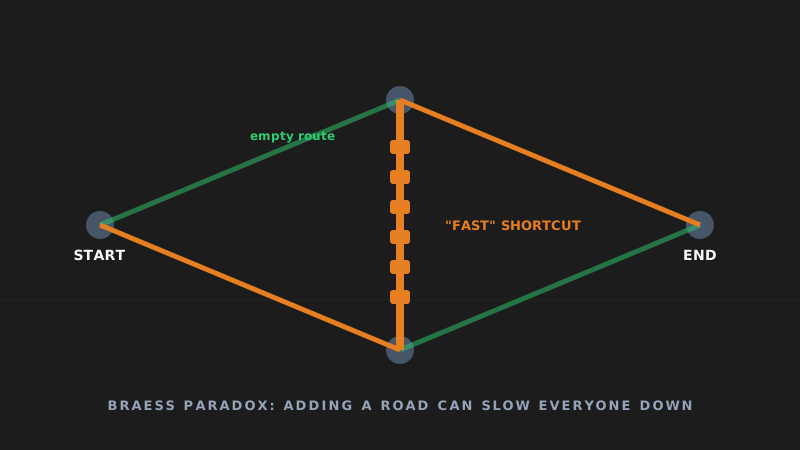
Imagine a simple network: a start point, an end point, and two routes between them — call them the upper route and the lower route. Each route has two segments. On each route, one segment's travel time is constant (a fixed delay, like a tunnel), and the other segment's travel time depends on how many cars use it (a congestion-dependent delay, like a highway). The system reaches an equilibrium when travel times on both routes are equal — because if one were faster, drivers would switch to it, increasing its congestion until the times balanced.
Now add a shortcut that connects the two routes in the middle — a bridge that lets drivers hop from one to the other. Intuitively, this should help: more options, more capacity, faster travel. But under the right cost structure, the shortcut changes the equilibrium in a way that makes everyone slower. Here's why: every individual driver, acting rationally and selfishly, takes the shortcut because it appears to offer a faster path. But when everyone takes the shortcut, the segments connected to it become congested. The shortcut that was fast for one driver is slow for all drivers — and because everyone uses it, no one can escape the congestion it creates.
Selfish routing — each driver minimizing their own travel time — can produce a network equilibrium that is worse for every driver than the social optimum. Adding capacity can move the system further from the optimum, not closer.
Nash equilibrium and the price of anarchy
The traffic network settles at a Nash equilibrium: a state in which no individual driver can improve their own travel time by unilaterally changing routes. Every driver is doing the best they can given what everyone else is doing. Yet the resulting equilibrium is not the best the system could do. There exists a "social optimum" — an assignment of drivers to routes that minimizes total travel time — but it requires coordination: some drivers must take slower routes so that others (and the system as a whole) can be faster.
The gap between the selfish equilibrium and the social optimum is called the "price of anarchy." In traffic networks, it is the ratio of total travel time under selfish routing to total travel time under optimal routing. The price of anarchy is always at least 1 (the optimum is by definition the best) and, for certain network structures, can be as high as 4/3 — meaning selfish routing can make the system up to 33% slower than it needs to be.
The deep lesson is that individual rationality and collective optimality are not the same thing. A system composed of self-interested agents does not automatically reach the best collective outcome. This is the central tension of game theory, and traffic is its most everyday manifestation.
Why the shortcut makes things worse
To see the mechanism clearly, consider what the shortcut does to incentives. Before the shortcut, drivers faced a binary choice: upper route or lower route. The equilibrium balanced the two. After the shortcut, drivers face a richer choice set — they can mix and match segments. This richer choice set changes the equilibrium.
The problem is that the shortcut is attractive precisely because it is underused. As soon as drivers discover it, they flood in. The shortcut's congestion rises until it is no longer faster — but by then, the routes it connects are also congested, because the shortcut has rerouted traffic in a way that overloads segments that were previously balanced. The system reaches a new equilibrium that is worse than the old one. The shortcut that promised speed delivered delay.
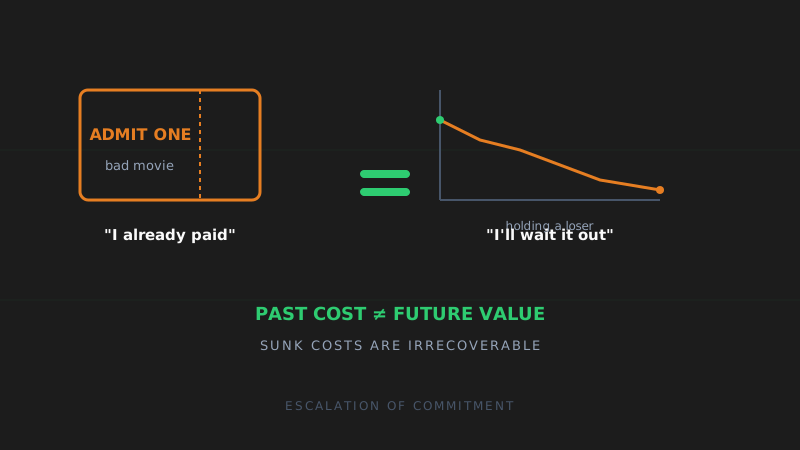
This is not a failure of driver intelligence. Each driver is responding correctly to the incentives as they perceive them. The failure is systemic: the incentive structure produces a bad equilibrium, and no individual driver can fix it by acting alone. The sunk cost fallacy keeps drivers on the congested route once they've committed to it, deepening the trap.
Real-world Braess
The paradox is not merely theoretical. Several documented cases show road removal improving traffic:
- Seoul, 2005. The city tore down the Cheonggyecheon elevated highway, a six-lane artery through the center. Traffic flow improved. The removal of capacity reduced congestion.
- New York, 1973. The closing of the West Side Highway led to redistributed traffic and, counter to predictions, did not produce gridlock on alternate routes.
- Stuttgart, 1969. A new road investment increased congestion; the paradox was named in the paper that analyzed why.
These cases don't prove that removing roads always helps — they prove that the relationship between capacity and congestion is not monotonic. Under the right network structure, less capacity can mean less delay. The intuition "more roads = less traffic" is sometimes exactly backwards.
The broader game-theoretic lesson
The Braess paradox generalizes beyond traffic. Any system in which many self-interested agents share congestible resources can exhibit the same pathology:
| Domain | The "shortcut" | The paradox |
|---|---|---|
| Internet routing | A new high-bandwidth link | Can increase latency for all traffic |
| Electricity grids | A new transmission line | Can reduce overall stability |
| Supply chains | A new fast supplier | Can create systemic bottlenecks |
| Skill markets | A new "hot" credential | Can devalue the credential for all holders |
In each case, the addition looks like pure improvement but changes the equilibrium in a way that harms the system. The pattern is the same: a resource that is valuable when underused becomes a liability when overused, and self-interested agents overuse it because each one, individually, is making the right call.
Can you fix it?
The fix for the Braess paradox is not more roads — it is coordination. The social optimum requires some drivers to take routes that are not, from their individual perspective, the fastest. This is exactly what choice architecture and pricing attempt to do: congestion charges, toll lanes, and route guidance systems are all mechanisms for shifting the selfish equilibrium toward the social optimum by changing the incentives.
Singapore's Electronic Road Pricing system adjusts tolls in real time based on traffic conditions, effectively internalizing the congestion externality: the driver pays for the delay they impose on others. London's congestion charge reduced central-city traffic by roughly 30%. These are not behavioral nudges in the soft sense — they are price signals that move the equilibrium.
The deeper point is that some problems cannot be solved by individual decisions. A traffic network is a game, and its outcome is determined by the structure of the game, not the intelligence of the players. You cannot route your way out of a bad equilibrium by being smarter than the other drivers, because the other drivers are also being smart, and the smartness cancels out into congestion.
The bottom line
The Braess paradox is the FreakOnomics theme in its purest form: a counterintuitive result that emerges from the interaction of rational agents, not from any individual's error. Everyone is doing the right thing. The system is still wrong. The lesson is that "the right thing" depends on what everyone else is doing — and when the game is structured badly, the individually right thing and the collectively right thing diverge.
Next time you're stuck in traffic on the "fast" route, surrounded by a thousand other drivers who made the same calculation you did, remember: you are all behaving rationally. The problem isn't you. The problem is the network, and the network is a game you cannot win by yourself.