There is a number in economics that breaks the rules. It isn't a trillion-dollar deficit or a record-breaking valuation. It's zero. When the price of something drops to zero, the demand curve doesn't just slope downward — it leaps off the page. And the people who offer you something for free know exactly what they're doing.
Consider a now-famous experiment by behavioral economist Dan Ariely. Researchers offered participants a choice between a Hershey's Kiss for one cent and a Lindt truffle for fifteen cents. The truffle — a clearly superior chocolate — was the popular choice. Then they dropped both prices by exactly one cent. The Kiss became free; the truffle cost fourteen cents. The preference reversed dramatically. People grabbed the free Kiss in droves, even though the relative value had not changed at all.
One cent is a trivial amount. Yet the difference between one cent and zero is not trivial. It is, psychologically, a different category of decision. And that gap is where the economics of free begins.
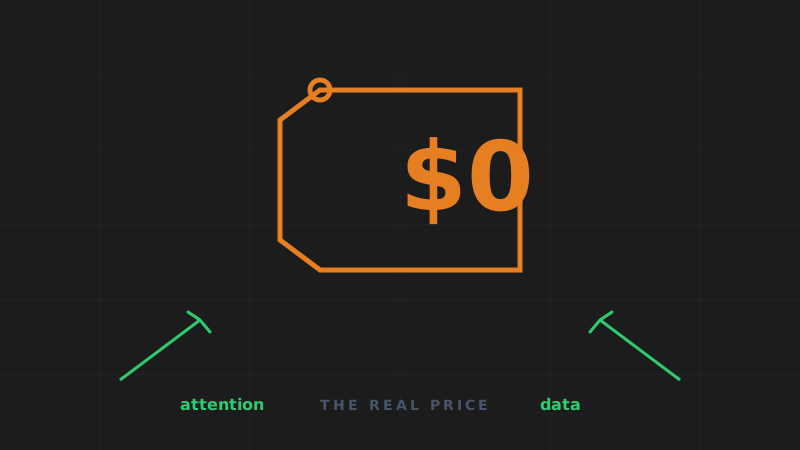
Why zero breaks the calculus
Standard economic theory treats price as a continuous variable. A good that costs $1.00 and a good that costs $0.01 sit on the same demand curve; lowering the price should increase quantity demanded in a smooth, predictable way. But behavioral research consistently shows that zero is discontinuous — there is a cliff at the boundary where price disappears.
The reason is that a positive price, however small, forces a comparison. You ask: is this worth a penny? Is it worth the trouble of a transaction? The moment money enters the picture, even trivially, you engage a slow, deliberative mode of evaluation. Remove the money entirely and that evaluation switches off. "Free" signals that there is nothing to lose, so you stop calculating what there might be to gain — or to give up.
A positive price activates cost-benefit analysis. A zero price deactivates it. That deactivation is the product.
The three hidden currencies
If you aren't paying with money, you are paying with something else. The "free" economy runs on three currencies that are harder to quantify and harder to refuse:
- Attention. A free app, a free newsletter, a free social feed — each is engineered to capture and hold your attention, which is then aggregated and sold to advertisers. You are not the customer; you are the inventory.
- Data. Free services collect behavioral data that would be impossible to purchase directly. The data is more valuable than any subscription fee you would have paid, because it predicts not just your behavior but the behavior of people like you.
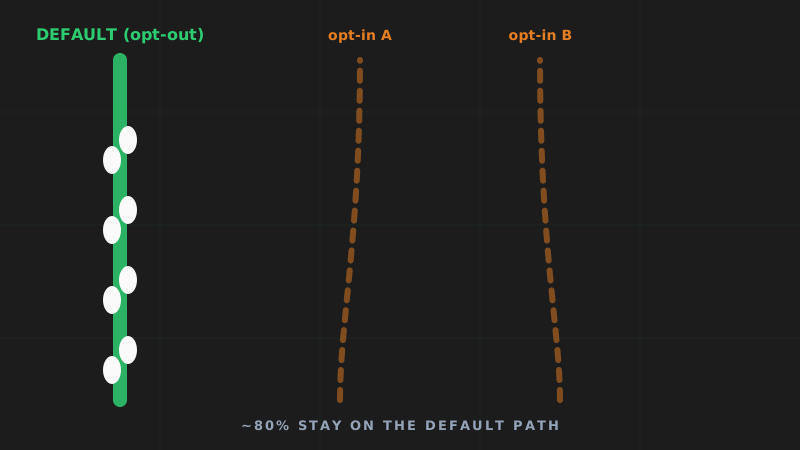
- Decision rights. Free products shape the defaults of your digital life — which search engine you use, which news you see, which purchases feel normal. Over time, these defaults become the architecture of your decisions.
The paradox is that each of these currencies is individually invisible. You don't feel a micropayment of attention the way you feel a micropayment of cash. But aggregated across millions of users and billions of interactions, they constitute some of the most valuable businesses ever built.
The zero-price effect in the wild
The economics of free isn't limited to tech platforms. It appears wherever a producer wants to maximize adoption rather than revenue per unit. Consider shipping thresholds: "free shipping over $35" is not generosity — it's a price discrimination mechanism that nudges you to fill your cart past the threshold, increasing average order value far more than the shipping cost. The word "free" does the heavy lifting; the threshold does the accounting.
Or consider the freemium software model. The free tier is not a loss leader. It is a customer-acquisition funnel whose conversion economics depend on the fact that free users recruit other free users, expanding the pool from which the paying minority is drawn. The free users are not being subsidized — they are subsidizing the system's growth.
When free is genuinely free
Not every zero price is a trap. Public goods — clean air, sidewalk conversation, a sunset — are genuinely free in the sense that no one is monetizing your attention or harvesting your data. Open-source software, when truly community-maintained, can approximate this. The distinguishing question is simple: if I am not paying, who is, and what are they paying for?
If the answer is "advertisers, for access to my attention," you are inside the attention economy. If the answer is "a community, for the shared benefit of the software," you are closer to a genuine public good. Most "free" things online are the former, dressed in the language of the latter.
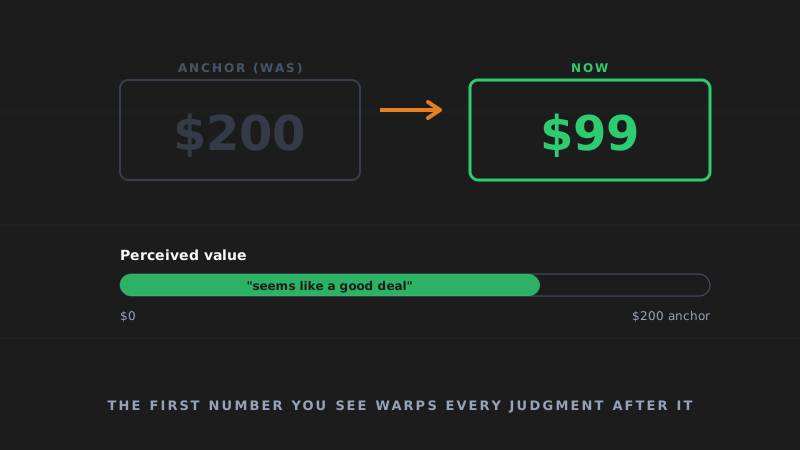
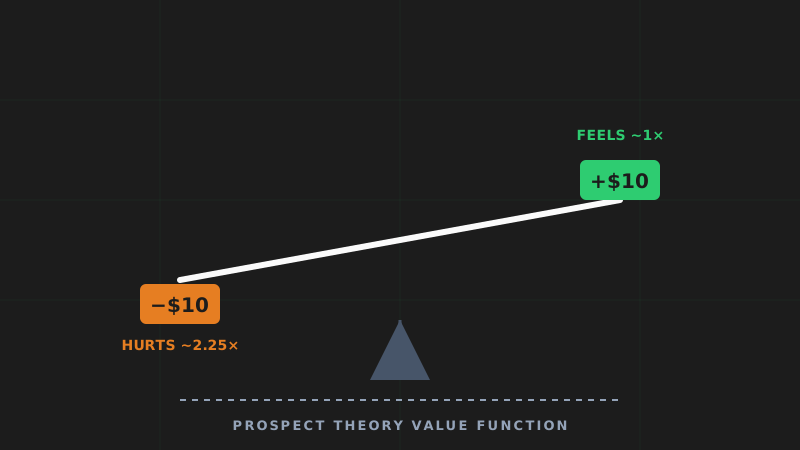
This connects to a broader theme we explore throughout FreakOnomics: the gap between stated price and true cost. The anchoring effect shows how an original price warps your sense of a deal. The asymmetry of loss and gain explains why free trials that require a credit card are so effective at converting users — the eventual charge feels like a loss, and we are built to avoid losses. The economics of free is the master pattern: it is the zero that makes every other behavioral lever more potent.
The defensive economics of free
You cannot opt out of the attention economy entirely, but you can change your default posture toward zero. A few principles, drawn from the decision-science literature:
- Price everything in time. If a free service costs you 20 minutes a day, that is roughly 121 hours a year — a non-trivial endowment. Ask whether you would pay the equivalent hourly value for what you received.
- Notice the comparison switch-off. When you reach for something free, pause and ask: would I take this if it cost one dollar? If the answer is no, the zero is doing your deciding, not you.
- Audit the data flow. Free services are data transactions. Periodically review what you have connected to what, and assume that any free tool is, at minimum, logging your behavior.
- Pay for the things that matter. The corollary of "if you're not paying, you're the product" is that paying can restore your status as the customer. For tools central to your work or privacy, a subscription is often the cheaper option in full-cost terms.
The bottom line
Zero is not a small price. It is a different kind of price — one denominated in currencies we are bad at tracking and worse at valuing. The most expensive things in your digital life probably cost you nothing up front. The companies that built them understood something the rest of us are still catching up to: that when you remove money from a transaction, you don't remove the cost. You just make it invisible.
The economics of free, in the end, is the economics of misallocated attention. And attention, unlike money, is non-renewable. You can earn more dollars. You cannot earn back the hour you spent scrolling a feed that cost you nothing and paid you nothing — while paying its creators handsomely.
That is why zero is the most expensive price. Not because of what it takes, but because of what it prevents you from noticing it took.