In Germany, roughly 12% of people consent to organ donation. In Austria, the figure is over 99%. The two populations are not dramatically different in values, religion, or attitudes toward donation. The difference is a single line in the law: Germany asks you to opt in. Austria assumes you're in unless you opt out. That gap — between a checkbox you must tick and a checkbox you must untick — is the entire field of nudge theory.
"Nudge," as defined by Richard Thaler and Cass Sunstein in their 2008 book of the same name, is any aspect of the choice architecture that alters people's behavior in a predictable way without forbidding any options or significantly changing their economic incentives. The key word is architecture. Choices are never presented in a vacuum; they are always embedded in a structure — a default, an order, a framing — and that structure does real work.
The power of the default
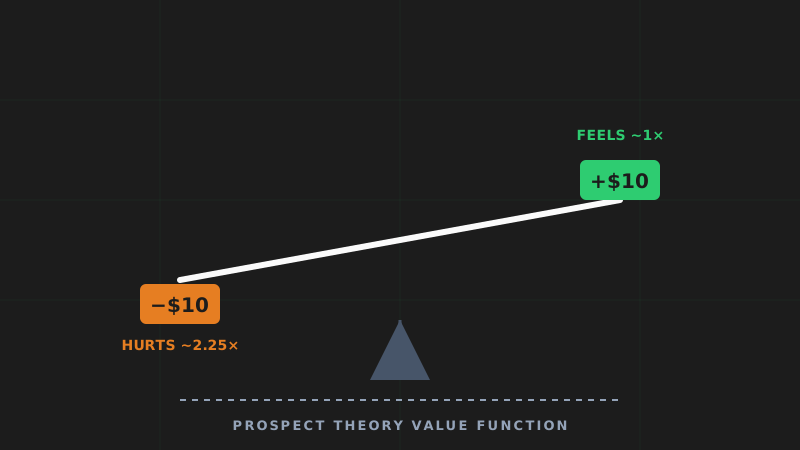
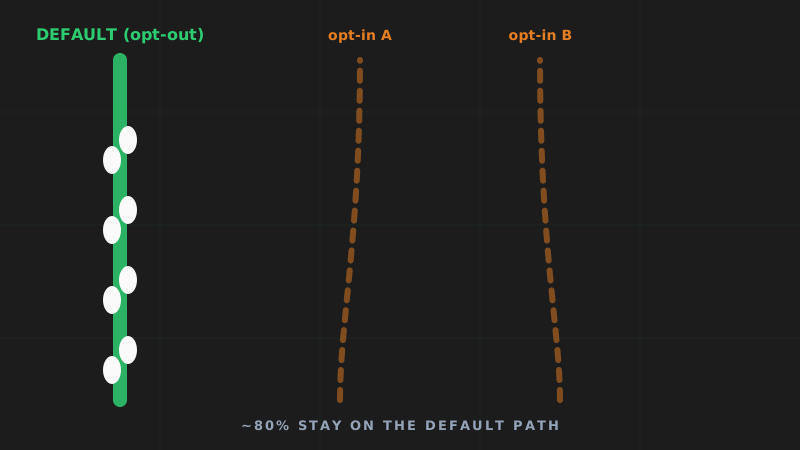
Of all the tools in the choice architect's kit, the default is the most powerful. A default is the option selected if you do nothing — and doing nothing is, experimentally, the most popular option. The reasons are layered: loss aversion makes any switch from the default feel like risking a loss; the default implies an endorsement (someone chose this for a reason); and the cognitive cost of evaluating alternatives is real, so the path of least resistance wins.
The organ donation example is the most famous, but the pattern repeats across domains:
| Domain | Opt-in rate | Opt-out rate |
|---|---|---|
| Organ donation consent | ~15% | ~90% |
| Retirement plan enrollment | ~40% | ~90% |
| Green energy participation | ~10% | ~70% |
These are not subtle differences. They are the difference between a policy that reaches a tenth of the population and one that reaches nearly all of it — achieved not by changing what people can choose, but by changing what they get if they don't choose.
Three forces converge: (1) loss aversion makes the default feel safer; (2) the default carries an implicit recommendation; (3) effort costs make inaction the easiest path. Together, they make the default the modal outcome.
Retirement savings: the auto-enrollment revolution
The most economically consequential application of default theory is in retirement savings. For decades, participation in employer-sponsored 401(k) plans required employees to actively enroll — fill out forms, choose a contribution rate, select investments. Participation rates hovered around 40%.
When employers switched to automatic enrollment — where new hires are enrolled at a default contribution rate unless they opt out — participation jumped to over 90%. The decision hadn't changed. The architecture had. Workers could still opt out; almost none did. The result was millions more people saving for retirement, purely because the checkbox was pre-ticked.
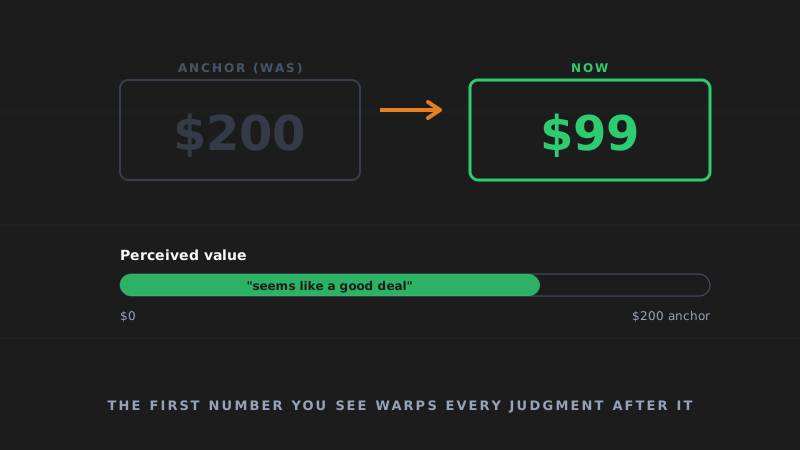
There is a catch, and it matters. Auto-enrollment at a low default rate (often 3%) gets people in the door but can leave them under-saving relative to what they'd have chosen if they'd engaged. The default is powerful, but a poorly chosen default can anchor people to a suboptimal number. This is the anchoring effect operating inside nudge theory: the default doesn't just determine participation, it shapes the magnitude of the choice.
Beyond defaults: the wider toolkit
Defaults are the headline act, but choice architecture includes other instruments:
- Order effects. The first item on a menu is chosen more often. The first candidate on a ballot gets a small but real bump. Order is a nudge.
- Framing. "95% fat-free" and "5% fat" describe the same product but elicit different responses. Framing doesn't change the facts; it changes which fact you feel.
- Social proof. Telling hotel guests that "75% of guests in this room reuse their towels" increases towel reuse more than environmental appeals. People look to what others do.
- Structuring complexity. A retirement form with three clear options gets better outcomes than one with twenty. Reducing choice overload is itself a nudge.
The ethics of nudging
Nudge theory has critics, and they raise a serious question: if defaults are this powerful, who decides what the default is? Thaler and Sunstein's answer is "libertarian paternalism" — preserve freedom of choice (libertarian) while steering people toward options that make them better off by their own lights (paternalism). The opt-out is always available; the architecture just determines the starting point.
The criticism is that "better off by their own lights" is doing a lot of work. A default can serve the default-setter's interests rather than the chooser's. An employer's default 401(k) fund might carry high fees. A platform's default privacy setting might maximize data collection. The architecture is never neutral; the question is whose preferences it encodes.
This is why FreakOnomics treats nudging not as a policy panacea but as a fact to be observed. Every choice environment has a default. Every default is doing work. The only question is whether you know which default you're sitting in — and whether it's serving you.
The takeaway
The nudge literature's most important finding is not that defaults can change behavior. It is how much they change it, and how cheaply. A policy that enrolls 90% of workers in retirement savings by pre-ticking a box accomplishes, at zero marginal cost, what financial education campaigns spend billions trying and failing to do. The lever is not information; it is architecture.
If there is a FreakOnomics lesson in nudging, it is this: the most important choice in any decision is often the one made before you arrive — the choice of what the default will be. And that choice, almost always, was made by someone other than you.