In 1970, a young economist named George Akerlof submitted a paper that three leading journals rejected. The paper argued that markets can break down entirely when one side knows more than the other — and the editors thought the claim was either obvious or wrong. It was neither. "The Market for Lemons" would become one of the most influential economics papers of the 20th century, and its logic explains far more than used cars.
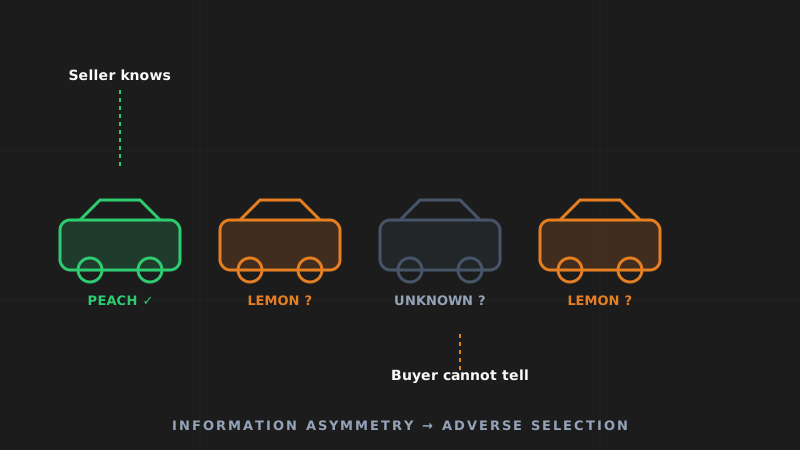
The setup is simple. In the used car market, the seller knows whether the car is a "peach" (reliable) or a "lemon" (a dud). The buyer cannot tell the difference by inspection. The buyer, knowing that some fraction of cars are lemons, will only offer a price that reflects the average expected quality — somewhere between the true value of a peach and the true value of a lemon.
Here is where the trouble starts. At that average price, peach owners don't want to sell — the price is below their car's true value. So they withdraw from the market. Only lemon owners remain, because the average price is above the lemon's true value. Buyers, anticipating this, lower their offer further. The spiral continues. In the extreme, the market unravels entirely: only lemons trade, or nothing trades at all.
The structure of the problem
Akerlof identified a specific market failure: adverse selection. It occurs when one party to a transaction has hidden information about the quality of what's being traded, and that information affects the terms of trade. The result is that the "bad" types are preferentially attracted to the transaction, while the "good" types exit.
The mechanism is not limited to cars. It appears wherever quality is hidden and price must be set before quality is revealed:
- Health insurance. People who expect to need medical care are more likely to buy generous coverage than healthy people. If insurers can't distinguish the two, they must price for the average — driving healthy people out and leaving a sicker, more expensive pool. This is the core problem the Affordable Care Act's individual mandate was designed to address.
- Labor markets. A job candidate knows their own productivity; the employer does not. Employers offer a wage based on average expected productivity. High-productivity workers, whose value exceeds the average wage, may not apply. The employer ends up with a lemons labor pool.
- Online platforms. Sellers on a marketplace know whether their goods are authentic; buyers cannot verify before purchase. Without a reputation mechanism, the market fills with counterfeits and buyers flee.
- Dating. Both parties present their best selves; true compatibility is hidden. The "market" for relationships is thick with adverse selection — you only learn quality after the transaction (the relationship) has begun.
When quality is hidden and price reflects average quality, high-quality sellers exit. The remaining pool is worse than average. Buyers lower their price. The cycle repeats until only lemons remain.
How markets fight back: signaling and screening
Markets don't always collapse — and the reason is that participants invent mechanisms to bridge the information gap. Two of the most important are signaling and screening.
Signaling is when the informed party takes a costly action that only a high-quality type would rationally take. Michael Spence (who shared the 2001 Nobel with Akerlof) used education as the canonical example. A degree is valuable to employers not necessarily because of what was learned, but because it is costly to obtain — costly enough that a low-productivity worker wouldn't bother. The degree functions as a credible signal of underlying quality. The signal works precisely because it is expensive for the wrong type to fake.
Screening is the mirror image: the uninformed party designs a menu of options that induces the informed party to reveal their type. Insurance deductibles are the classic case. An insurer offers a high-premium, low-deductible plan and a low-premium, high-deductible plan. Sick people, who expect to use a lot of care, pick the first. Healthy people pick the second. The menu screens the types apart — the insurer never directly observes health, but the choice reveals it.
Warranties, reputation, and the lemons antidote
In the original car market, several institutions arose precisely to combat the lemons problem:
- Warranties. A seller who offers a multi-year warranty is credibly signaling that they don't expect the car to break down. A lemon seller couldn't afford the warranty. The warranty is a signal that costs the right people more.
- Certified pre-owned programs. Manufacturers inspect and certify used cars, attaching their own reputation. The certification converts hidden quality into observable quality — at a price premium.
- Reputation systems. eBay, Amazon, and Airbnb all solve lemons problems with review mechanisms. Repeated transactions plus visible ratings make quality observable over time, even when it is hidden in any single transaction.
- Regulation. Lemon laws mandate disclosure and provide recourse, shifting the cost of hidden defects back onto sellers. This is the state stepping in where private signaling is insufficient.
Each of these mechanisms has a cost: warranties are priced into the car, certification commands a premium, reputation systems can be gamed, regulation creates compliance overhead. The market for lemons doesn't disappear — it is managed, at a price.
The platform era: lemons at scale
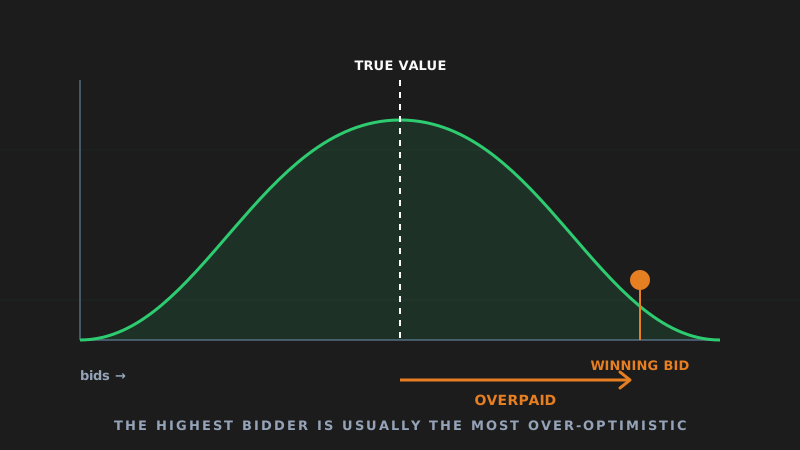
Information asymmetry has not gone away in the digital economy; it has changed shape. Online marketplaces initially worsened the lemons problem — a stranger in another city selling a used phone is the purest possible lemons scenario. But platforms responded with reputation systems, money-back guarantees, and escrow. The winner's curse appears in auction markets on these same platforms: the highest bidder for an item of uncertain quality is, by definition, the one who estimated the quality most optimistically.
The deeper problem is that reputation systems themselves are vulnerable. Fake reviews, review bombing, and purchased ratings all attempt to corrupt the signal. When the signaling mechanism degrades, the lemons problem returns — and the platform that fails to maintain signal integrity loses its buyers. Trust is the infrastructure of the lemons-resistant market, and it is expensive to build and easy to erode.
Why this paper mattered
Before Akerlof, standard economics assumed that markets clear because buyers and sellers have symmetric information — or that asymmetric information is a minor friction. Akerlof showed that asymmetry is not a friction; it is a force that can make markets fail entirely. The implication is that the institutions we take for granted — warranties, certifications, regulations, reputation systems — are not optional decorations on a market that would work fine without them. They are the load-bearing structures that prevent the market from collapsing into lemons.
This is the FreakOnomics theme in miniature: the visible economy (a used car lot, an insurance exchange, a dating app) rests on invisible architecture (signaling, screening, reputation) that exists to solve a problem most participants never consciously identify. The market for lemons is everywhere, and so are the mechanisms that hold it at bay — imperfectly, expensively, and always under threat.