Imagine you find a ten-dollar bill on the sidewalk. Now imagine you reach for your wallet and realize a ten-dollar bill is missing. The amounts are identical. The events are mirror images. But they do not feel remotely the same — and that asymmetry is one of the most consequential facts in behavioral economics.
You already know this from experience. The mild pleasure of finding ten dollars fades in minutes. The gnawing annoyance of losing ten dollars can linger for an afternoon. This isn't a moral failing or a sign of poor emotional regulation. It is a systematic, measurable feature of how human beings evaluate outcomes — and it shapes everything from insurance markets to stock trading to how you feel about a restaurant surcharge.
The 2.25 number
In 1979, Daniel Kahneman and Amos Tversky published a paper called "Prospect Theory: An Analysis of Decision under Risk." It would eventually help earn Kahneman the Nobel Prize. The paper's central empirical claim was that people do not evaluate gambles by computing expected utility, as standard economics assumed. Instead, they evaluate outcomes as gains or losses relative to a reference point — usually the status quo — and they weigh losses substantially more heavily than gains.
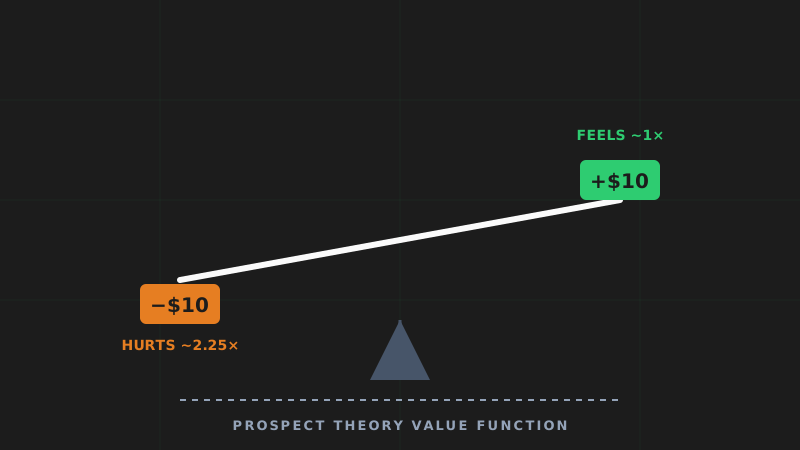
How much more heavily? Kahneman and Tversky's experimental data estimated the loss-aversion coefficient at roughly 2.25. That is, the psychological impact of losing $100 is about 2.25 times the impact of gaining $100. A loss must be paired with a gain roughly 2.25 times as large to feel equally compelling.
Loss aversion coefficient ≈ 2.25. Losses hurt about 2.25× more than equivalent gains please. The exact value varies by study and context, but the asymmetry is robust across cultures, ages, and stakes.
This single number explains an enormous amount of otherwise puzzling behavior. Why do people buy insurance even when the premium exceeds the expected payout? Because the weighted pain of the potential loss exceeds the certain cost of the premium. Why do investors hold losing stocks too long and sell winning stocks too early? Because realizing a loss forces you to feel it, while holding keeps the loss "paper" and the hope alive. Why does a $5 fee feel like an outrage when it appears on a bill that was supposed to be free? Because fees are framed as losses, and losses are amplified.
The endowment effect: why what you own feels worth more
Loss aversion has a close cousin called the endowment effect. In a classic experiment, researchers gave half the participants a coffee mug and asked them the minimum price they'd accept to sell it. They asked the other half — who had no mug — the maximum they'd pay to buy one. Standard economics predicts the two numbers should be roughly equal. They weren't. Sellers demanded about twice as much as buyers were willing to pay.
The explanation is loss aversion. For the seller, giving up the mug is a loss. For the buyer, acquiring it is a gain. Because losses loom larger, the seller's reservation price sits well above the buyer's. The mug hasn't changed. Only the reference point has — and the reference point is what the brain actually prices.
This is why free trials are so effective at converting users. Once you have used a service for two weeks, it becomes part of your reference point. Cancelling feels like a loss, and loss aversion makes you reluctant to incur it — even if you would never have paid for the service in the first place. The economics of free and the psychology of loss aversion work together: free gets you in the door, loss aversion keeps you there.
Where loss aversion becomes expensive
Loss aversion isn't always harmful — it makes us appropriately cautious about irreversible decisions. But it systematically distorts judgment in several high-stakes domains:
| Domain | Loss-averse behavior | Cost |
|---|---|---|
| Investing | Holding losers, selling winners | Lower returns; tax inefficiency |
| Negotiation | Refusing to concede, even when the deal is good | Deadlocks; missed agreements |
| Career | Staying in a bad job to avoid the loss of stability | Compounding opportunity cost |
| Consumption | Over-insuring against small losses | Wasted premiums |
| Subscriptions | Not cancelling unused services | Chronic overpayment |
In each case, the pattern is the same: the felt cost of the loss is larger than the actual cost, and the felt benefit of the alternative is smaller than the actual benefit. Loss aversion makes the status quo feel safer than it is.
Status quo bias and the default trap
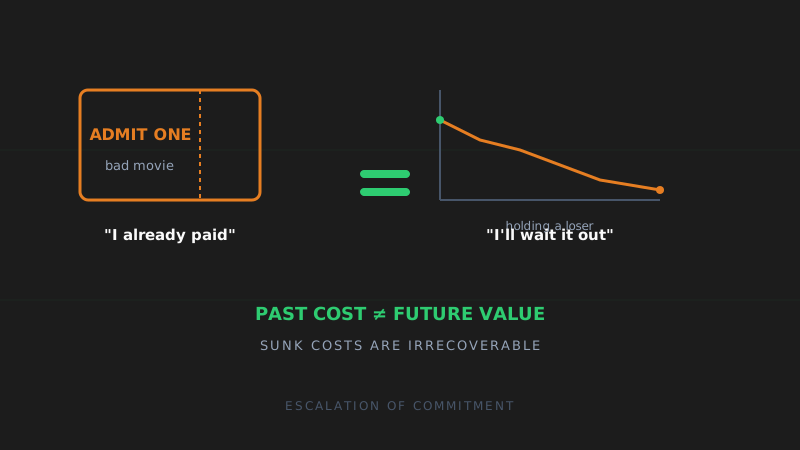
Loss aversion is the engine behind status quo bias — our tendency to stick with the current option even when a change would be clearly beneficial. Every change involves giving something up, and giving something up is coded as a loss. The cumulative effect is that we drift: we keep the insurance plan we picked at age 25, the investment allocation we set during our first job, the subscription we started for a project that ended. The sunk cost fallacy compounds this — we tell ourselves we've already "invested" in the current path, as if past spending justifies future losses.
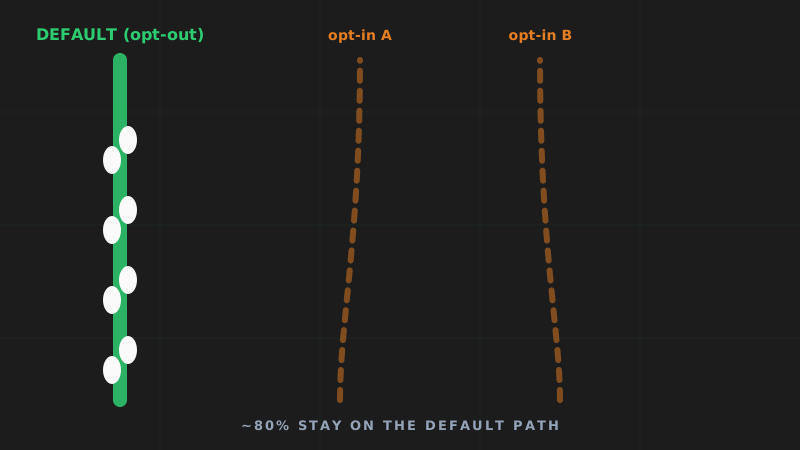
This is also why default options are so powerful. The default is the reference point, and deviating from it feels like risking a loss. Policymakers who set defaults — for retirement savings, organ donation, green energy — are quietly exploiting loss aversion at population scale.
Can you debias loss aversion?
Loss aversion is deep-wired, but its effects can be moderated. The most effective strategy is reframing: instead of asking "what do I lose by changing?" ask "what do I gain by changing, and what do I lose by staying?" This forces the status quo to be evaluated as a choice rather than a baseline — and choices can be weighed.
A second strategy is pre-commitment. Decide in advance, when you are not facing the loss, what conditions would trigger a change. "I will sell this stock if it drops below $40" is easier to honor than a decision made in the grip of a paper loss, because the rule was set when the loss was hypothetical.
A third is to externalize the reference point. Investors who check their portfolios rarely are less loss-averse than those who check daily, because they encounter the losses less frequently and feel them less acutely. Reducing exposure to the signal reduces the bias.
The bigger picture
Loss aversion is not a bug — it is a feature of a mind that evolved in an environment where losses were often irreversible and occasionally fatal. Losing your food cache could mean starvation; finding extra food was merely a bonus. The asymmetry made sense when the downside was existential. In a modern economy where most losses are recoverable and most decisions are reversible, the same asymmetry becomes a systematic source of error.
The FreakOnomics project is largely about this gap: the gap between the intuitions we inherited and the economy we actually inhabit. Loss aversion is perhaps the cleanest example. It is the reason a ten-dollar loss and a ten-dollar gain are not mirror images, and the reason your wallet — and your portfolio — behave in ways that puzzle the rational-actor model.
The loss-aversion coefficient of 2.25 is not a universal constant. But the direction is reliable: losses hurt more. Knowing that, and accounting for it, is most of what "good decision-making under risk" actually means.