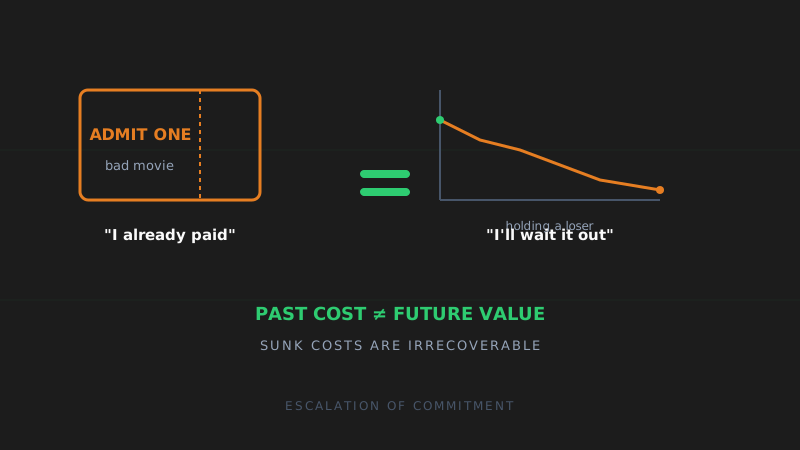
You are forty minutes into a terrible film. The ticket cost $14. You could leave and reclaim ninety minutes of your evening. Instead, you stay — because you "already paid for it." Across town, an investor is holding a stock that has lost 40% of its value. He could sell, take the loss for tax purposes, and reallocate to a better prospect. Instead, he holds — because selling would "lock in" the loss. Two different situations, identical error.
The error is the sunk cost fallacy: allowing costs that have already been incurred and cannot be recovered to influence a decision about the future. It is one of the most robust biases in the behavioral literature, and it appears wherever humans invest time, money, or effort and then face the question of whether to continue or cut.
The logic, stated plainly
In principle, the rule is simple: sunk costs are sunk. A cost that cannot be recovered is irrelevant to a forward-looking decision, because it will be incurred regardless of what you do next. The $14 for the movie ticket is gone whether you stay or leave. The 40% loss on the stock is realized whether you hold or sell — the value has already moved. The only question that should guide the decision is: going forward, which option has the higher expected value?
Staying in the bad movie has an expected value of suffering for ninety more minutes. Leaving has an expected value of reclaiming that time. The ticket price does not enter the calculation, because it is identical in both branches of the decision tree. Yet psychologically, it dominates the calculation — because walking out "wastes" the $14, and waste feels like a loss.
A rational decision-maker considers only future costs and future benefits. Past, irrecoverable costs are irrelevant. Any decision weighted by sunk costs violates this principle — and most human decisions are.
Why we fall for it
The sunk cost fallacy is not a random error. It has a coherent psychological structure, built from several deeper biases working together:
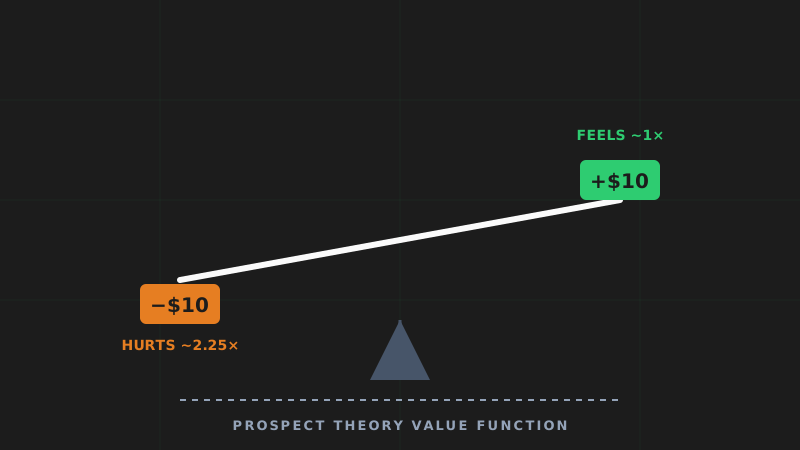
Loss aversion. As we explored in our piece on loss aversion, losses hurt roughly 2.25 times as much as equivalent gains please. Abandoning a project means realizing a loss — and the felt weight of that loss is disproportionate. Continuing avoids the felt loss, even when it ensures a larger actual one.
Desire not to appear wasteful. "I already put so much in" is the signature phrase of the fallacy, and it carries a moral charge. Quitting feels like admitting the prior investment was a mistake. The fallacy is partly a defense of the past self's judgment.
Identity and commitment. When we have publicly committed to a path — a degree, a business, a relationship — abandoning it feels like a repudiation of who we said we were. The sunk cost becomes entangled with self-image, and self-image is expensive to revise.
Uncertainty about the alternative. Staying in a known-bad situation feels safer than risking an unknown one, even when the expected value of the unknown is higher. The fallacy is amplified by ambiguity aversion.
The Concorde and the naming of a fallacy
The sunk cost fallacy is sometimes called the "Concorde fallacy," after the supersonic airliner jointly developed by the British and French governments. By the time it became clear the Concorde would never be commercially viable, billions had been spent. The project continued anyway — partly because abandoning it would mean admitting the billions were wasted. The planes flew for 27 years and never recouped their development costs.
The Concorde is the textbook case because the numbers were large and public. But the same logic plays out in smaller, private theaters: the half-finished novel you can't abandon, the renovation that keeps expanding, the relationship you "invested so much in." The fallacy scales from billions to minutes.
Where sunk costs do the most damage
| Domain | Manifestation | The rational move |
|---|---|---|
| Investing | Holding losers to "wait for recovery" | Evaluate future prospects only; tax-loss harvest |
| Careers | Staying in a degree or job because of years invested | Compare forward options, not backward costs |
| Projects | "We're 80% done" justifies finishing a doomed effort | Ask: would I start this today? If not, stop. |
| Relationships | "We've been together so long" as a reason to stay | Future compatibility, not past duration |
| Subscriptions | Not cancelling what you pre-paid for | Money is gone; use value going forward |
The pattern in every row is the same: a backward-looking cost is allowed to override a forward-looking comparison. The cure is the same in every row: reframe the decision as if you were starting fresh today. If you wouldn't start the project now, why are you continuing it? If you wouldn't buy the stock at its current price, why are you holding it? The question "would I begin this today?" strips the sunk cost out of the frame and forces a clean evaluation.
Organizational sunk costs: escalation of commitment
The fallacy is especially dangerous inside organizations, where it goes by the name "escalation of commitment." A manager who championed a project has every incentive to continue funding it — admitting failure damages her reputation, while continuing preserves the option that things might turn around. The result is that failing projects absorb disproportionate resources, because the decision-makers are personally invested in the narrative of eventual success.
This is why well-run organizations build in "kill criteria" — pre-committed thresholds at which a project is automatically reviewed or cancelled, regardless of the emotional state of its champions. The kill criterion removes the decision from the moment of sunk-cost pressure and relocates it to a calmer, earlier point in time. It is, in effect, a choice-architecture intervention: structuring the decision environment so the right call is easier to make.
Debiasing yourself
The sunk cost fallacy cannot be eliminated — the pull of "but I've already invested so much" is too deeply wired. But it can be moderated with three habits:
- Run the "fresh start" test. Ask: if I had not already invested anything, would I start this today on its current merits? If no, the sunk cost is the only thing keeping you in — and sunk costs are not a reason.
- Separate the decision from the past. Write down the future costs and future benefits of continuing vs. quitting. Do not include past spending. If the future case for continuing is weak, the past doesn't rescue it.
- Pre-commit kill criteria. Before you begin anything costly, define the conditions under which you will stop. Deciding the exit while the entry is still hypothetical is far easier than deciding it after the money is gone.
The bottom line
The sunk cost fallacy is the error of letting the past tax the future. It keeps us in bad movies, bad investments, and bad projects — not because continuing is the right call, but because quitting feels like losing, and losses loom large. The economics is unambiguous: sunk costs are irrelevant. The psychology is equally unambiguous: they don't feel irrelevant. The gap between the two is where most of our wasted time, money, and effort lives.
The FreakOnomics lesson is not that you should always quit. It is that the reason "I've already invested so much" is never a valid reason. Valid reasons look forward. Invalid ones look back. Most of us, most of the time, are looking back — and paying for it, again and again, with money we've already lost.