In 1971, three petroleum engineers working at Atlantic Richfield published a paper with a strange claim: oil companies that won competitive bidding for offshore drilling leases were systematically losing money. The winners weren't paying too much because they were reckless — they were paying too much because they won. The act of winning was itself the evidence that they had overpaid. They named the phenomenon the "winner's curse."
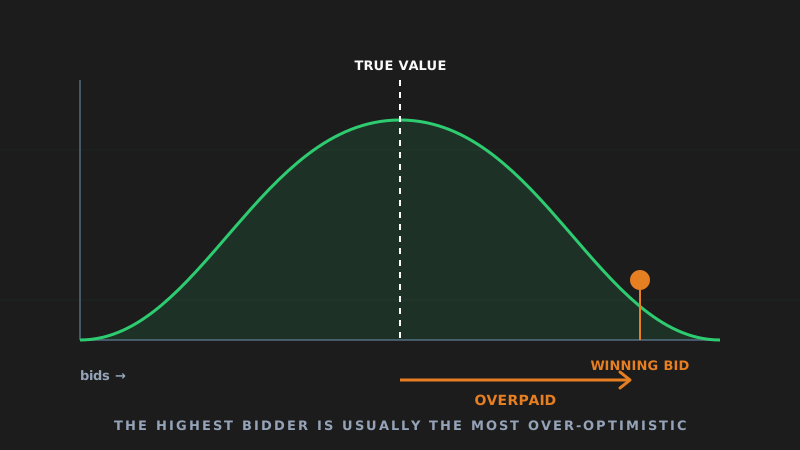
The logic is not immediately obvious, but once you see it, it is hard to unsee. And it applies to far more than oil leases. Every auction for an asset of uncertain common value — from corporate acquisitions to spectrum licenses to houses in a hot market — carries the same structural risk. The winner is, by definition, the bidder who placed the highest value on the asset. If the bidders are estimating the same underlying value with error, the highest estimate is, statistically, the one that overshoots the truth the most.
Common value vs. private value
The winner's curse applies specifically to common-value auctions — auctions where the item has a single underlying value that is the same for all bidders, even though no one knows exactly what it is. An oil lease is the classic case: the amount of oil under the seabed is a fixed quantity; each bidder estimates it differently, but there is one true answer. The same is true of a company being acquired (it has one true future cash-flow value) or a Treasury bill (it has a fixed face value).
This is different from a private-value auction, where the item's value differs by bidder. A painting you love is worth more to you than to someone who hates it; there is no single "true" value. In private-value auctions, winning just means you valued it most, and since you're the one who wanted it, that's fine. The curse doesn't bite.
The curse bites in common-value settings because the winner's high estimate is, statistically, an overestimate. If ten bidders each draw an estimate of the true value with unbiased error, the expected value of the maximum estimate is above the true value. The winner, who bid based on the highest estimate, has bid above the true value. They have won the auction and lost money, in the same instant.
In a common-value auction with N unbiased estimators, the expected value of the winning (highest) bid exceeds the true value. The more bidders, the worse the curse — because a larger field makes extreme overestimates more likely.
Why rational bidders shade down
If you know about the winner's curse, the rational response is to bid less than your estimate. This is called "bid shading." You don't bid your best guess of the value; you bid your best guess conditional on winning — and conditional on winning means conditional on your estimate being the highest, which means conditional on your estimate being an overestimate.
The math of optimal shading depends on the number of bidders and the distribution of estimation errors. With more bidders, you should shade more aggressively, because a larger field means the winning bid is more likely to be an outlier. With fewer bidders, you shade less. The fully rational bidder, in equilibrium, shades exactly enough that — conditional on winning — they expect to break even. The curse is "solved" by bidding as if you already know you'll win, and asking what that tells you about your estimate.
The problem is that most real bidders don't shade correctly. They either ignore the curse (bidding their raw estimate, which guarantees overpayment on average) or shade too little (accounting for the curse but underestimating its severity). The result, documented across oil leases, spectrum auctions, and M&A deals, is that auction winners systematically overpay.
Where the curse appears
| Setting | Common value | Curse evidence |
|---|---|---|
| Offshore oil leases | Barrels of oil in place | Winners underperformed risk-free returns (Capen et al., 1971) |
| Corporate acquisitions | Synergy-adjusted target value | Acquirers' stock falls at announcement; long-term underperformance |
| Baseball free agency | Player's future WAR | Top contracts consistently outperform production |
| Spectrum auctions | License's revenue potential | Several winners defaulted or went bankrupt |
| Real estate bidding wars | Future resale value | Winners in hot markets overpay vs. later appraisals |
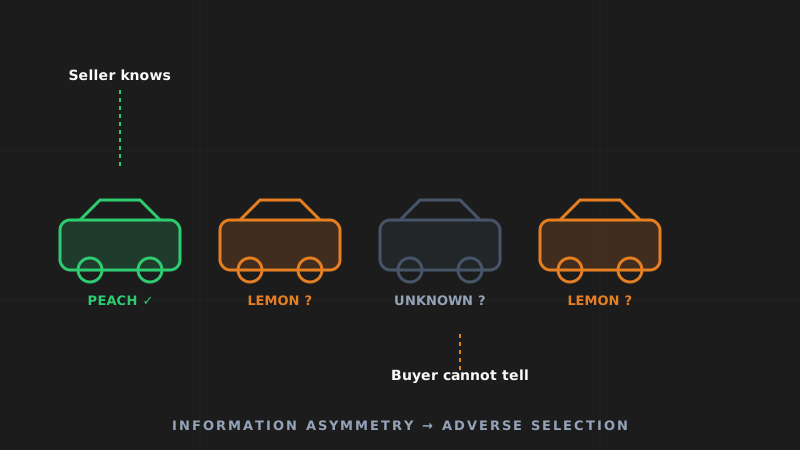
The pattern is consistent: the winner is the bidder who was most optimistic, and optimism in a common-value setting is, on average, error. This is the same adverse-selection logic we explored in the market for lemons — the selection mechanism (winning the auction) is correlated with the undesirable trait (overestimation). The difference is that in the lemons problem, the seller has hidden information; in the winner's curse, no one has hidden information. The curse arises purely from the statistical structure of competitive bidding.
The curse in everyday life
You don't have to bid on oil leases to encounter the winner's curse. It appears in subtler forms:
- Job offers. If you're the candidate who accepted a salary far above what others would have accepted, you may have been the one who most overestimated the job's value (or underestimated its costs). The fact that you "won" the negotiation is a signal about your estimate, not just about your leverage.
- Real estate. In a bidding war, the winner is the buyer who valued the house most. If the house has a single market value (it does — the price a future buyer will pay), the winner's high valuation is, on average, an overvaluation.
- Startup funding. The startup that raises at the highest valuation has, by definition, found the investor with the most optimistic estimate. If the startup's true value is common (it's the same company regardless of who values it), the highest valuation is the one most likely to be wrong.
- Dating and marriage. A loose analogy: the person who "wins" a competitive dating market may be the one who most overestimated the partner's long-term value. The curse doesn't map perfectly (relationships have private-value elements), but the selection logic rhymes.
Connecting to loss aversion and escalation
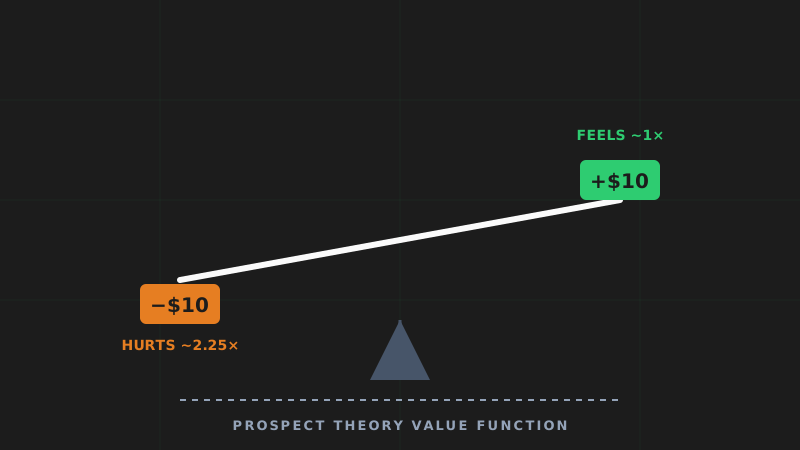
The winner's curse is bad enough on its own, but it compounds with other biases. Once you've won the auction and the value comes in below your bid, loss aversion makes it painful to admit the overpayment. You hold the asset, hoping it recovers — and sunk-cost reasoning keeps you committed to a position that was a mistake from the start. The curse creates the loss; the biases prevent you from cutting it.
This is why disciplined auction participants set walk-away prices in advance, before the competitive psychology of bidding takes hold. A pre-committed ceiling forces you to decide, in a calm state, the maximum you'd pay given your understanding of the curse. Without it, the heat of the auction — the fear of losing the item to a rival — drives bids past the rational boundary, and the curse deepens.
How auction design fights the curse
Auction designers have tools to mitigate the winner's curse. The most important is the auction format itself. A second-price (Vickrey) auction, where the highest bidder wins but pays the second-highest bid, reduces the incentive to shade and, under certain conditions, leads to more efficient outcomes. Sealed-bid formats reduce the herding and escalation of open ascending auctions. And disclosure rules — how much information bidders have about each other's estimates — affect the severity of the curse.
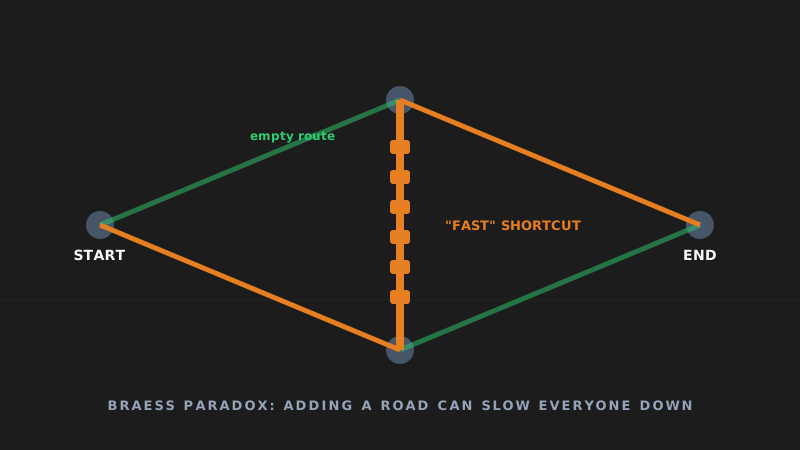
The deeper design lesson is that the rules of the auction determine the outcome as much as the bidders' valuations do. This is the same lesson as the Braess paradox: the structure of the game shapes the equilibrium, and a badly structured game produces bad outcomes even when the players are rational. Auction design is, in this sense, a form of choice architecture — the rules nudge the outcome.
The takeaway
The winner's curse is a reminder that "winning" is not always a signal of being right. In a common-value setting, winning is a signal that your estimate was the highest — and the highest estimate is the one most likely to be too high. The rational bidder internalizes this: they don't ask "what is this worth to me?" but "what is this worth, given that I'm about to win?" Those are different questions, and the difference is where the money is lost.
The FreakOnomics lesson is that competition has a hidden cost. When you win a competitive process for an asset of common value, you have not just acquired the asset — you have received information: that you valued it more than everyone else. That information is usually bad news. The curse isn't that you won. The curse is that winning told you something about your own judgment that you didn't want to know.