In Japan, tipping is not expected, not customary, and in some cases considered rude. In the United States, the expected tip on a restaurant meal is 18-20%, and failing to leave it is a minor social offense. The service in both countries is broadly comparable. The food costs are not wildly different. Yet the American diner pays a 20% premium on top of the listed price that the Japanese diner does not. Why?
The standard answer — "tipping rewards good service" — does not survive contact with the data. Study after study has found that tip size is only weakly correlated with service quality. Tips are far more strongly predicted by social norms, the size of the bill, whether the server touched the customer's shoulder, and whether the weather is sunny. Tipping is not, in practice, a performance evaluation system. It is a social-norm compliance system — and like all such systems, it is designed to make non-compliance feel costly.
The three forces behind the tip
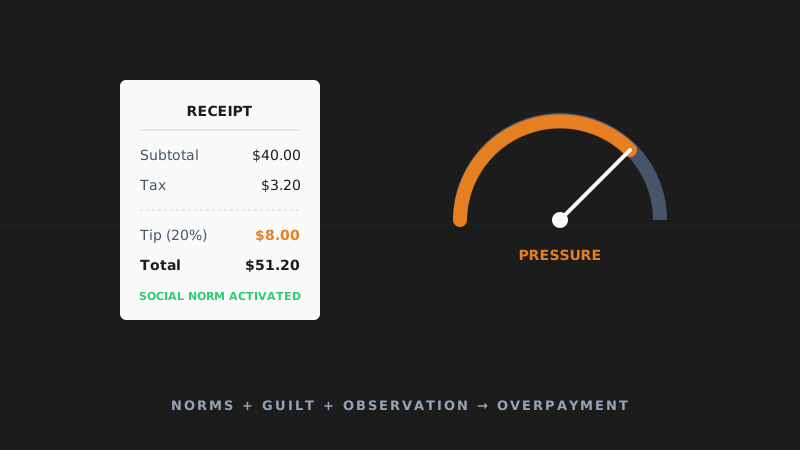
Behavioral research identifies three mechanisms that sustain tipping, none of which is "rewarding good service":
1. Social observation. People tip more when they are dining with others, when the server is watching, and when the tip is entered in front of the server. The mere presence of observation increases compliance. This is why tablet-based payment systems that display tip suggestions while the cashier watches are so effective at extracting tips even for counter service, where the traditional service justifications don't apply.
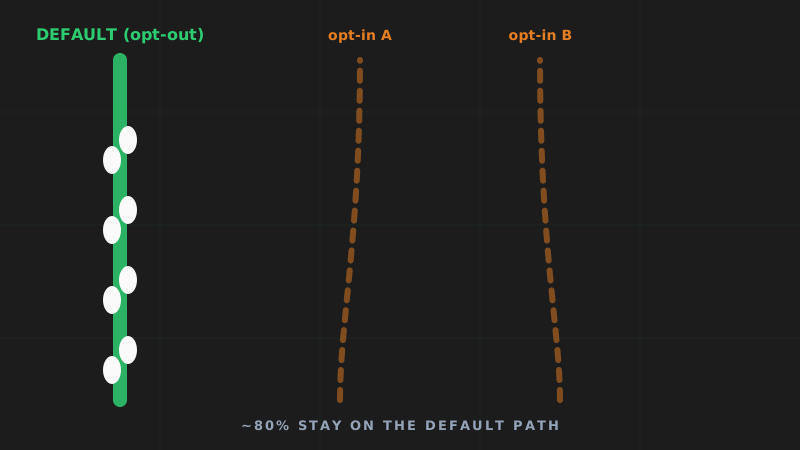
2. Guilt and the default option. Modern point-of-sale systems present tipping as a default with pre-set buttons (15%, 18%, 20%, 22%). The "no tip" option, when present, is often a small text button that requires an extra tap. This is choice architecture in action: the defaults and the friction are designed to make the tip the path of least resistance, and to make non-tipping feel like a deliberate, conspicuous choice.
3. Reciprocity and the small gift. A classic study found that restaurant tips increase significantly when a server brings a small mint with the bill. The mint is a trivial gift — worth pennies — but it activates the reciprocity norm: someone gave me something, so I should give something back. The tip increase is worth far more than the mint. The server is, in effect, buying a tip for a fraction of its value.
Meta-analyses of tipping studies find the correlation between service quality and tip percentage is around r = 0.11 to 0.14 — statistically real but explaining less than 2% of the variance. Bill size, group composition, and social context matter more.
The global variation that gives the game away
If tipping were about service, we would expect it everywhere. We don't. The variation across countries is enormous:
| Country | Expected tip | Structure |
|---|---|---|
| USA | 18-20% | Tipped minimum wage; tips = income |
| Canada | 15-18% | Similar to USA |
| UK | 10-12.5% | Often service charge added |
| France | ~5% (included) | Service compris by law |
| Japan | 0% | Not customary; can offend |
| Australia | 0-10% (optional) | Full wages; tips are bonus |
The pattern is telling. Countries where servers earn a full wage (Japan, Australia, much of Europe) do not have a tipping norm. Countries where tipped workers are paid a sub-minimum wage (USA) have a strong tipping norm. The norm exists to subsidize the wage, not to reward the service. The "reward for good service" story is the moral cover for a labor-cost structure.
The tip creep problem
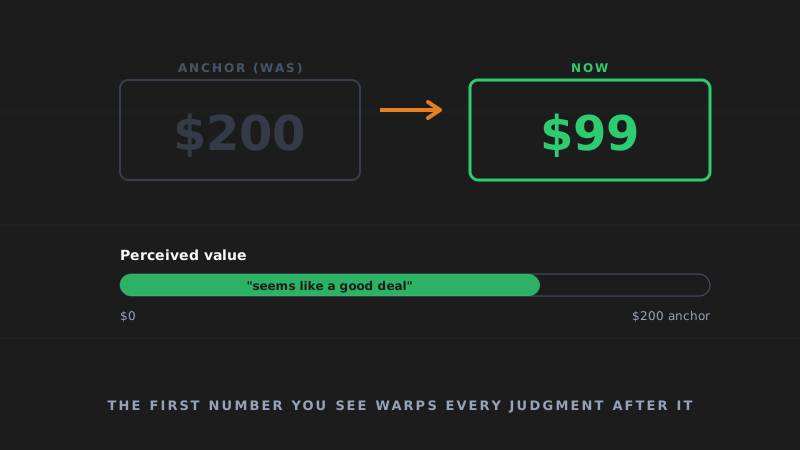
In recent years, tipping has expanded beyond restaurants into domains where it has no historical or logical basis: coffee shops, food trucks, retail counters, and self-service kiosks. The expected percentage has also crept upward — from 15% as the standard a decade ago to 20% or more today. This is "tip creep," and it is a textbook case of anchoring: the suggested tip buttons on a payment tablet set the anchor, and the anchor migrates upward over time.
The tablet interface is the key technology. By presenting three or four tip options as large buttons and the "no tip" option as small text, the interface makes tipping the default and non-tipping the deviation. The cashier's presence adds observation. The result is that customers tip for counter service — where there is no table service to reward — at rates approaching restaurant tipping. The architecture, not the service, drives the payment.
Why we comply
The deeper question is why customers go along with a system that extracts payment through social pressure rather than transparent pricing. Three reasons, all behavioral:
- Loss aversion. The social cost of undertipping — the server's disappointment, the risk of being remembered — is felt as a loss, and losses loom larger than the monetary cost of the tip. We pay to avoid the felt cost.
- Norms as defaults. Once a tipping norm is established, it becomes the default behavior, and deviating from it requires active effort. The default wins, as defaults do.
- Moral self-signaling. Tipping lets us signal generosity to ourselves. We tip not (only) to help the server but to feel like the kind of person who tips. The payment buys a self-image.
Who the system actually serves
Tipping benefits restaurant owners, not servers, in the long run. By shifting compensation to the customer's discretion, owners can pay a lower base wage — in the US, the federal tipped minimum wage is $2.13/hour, unchanged since 1991. The customer makes up the difference, and the variability is borne by the server, not the employer. Tipping is, structurally, a transfer of wage risk from the employer to the worker and the customer.
It also introduces wage inequality within the restaurant. Servers in high-revenue establishments earn far more than cooks, dishwashers, and bussers — sometimes more than the kitchen staff combined — even though the kitchen's work is equally essential. The tipped system routes money to front-of-house staff based on bill size, not on the quality or difficulty of the work.
The FreakOnomics view
Tipping is not irrational. It is a rational response to an irrational system — one that uses social pressure to complete a wage that the listed price doesn't cover. The FreakOnomics lesson is to see the system for what it is: a pricing structure where the listed price is a discount on the real price, and the missing portion is extracted through guilt, observation, and architecture.
The practical move is not to stop tipping — that just punishes the server for a system they didn't design. It is to recognize that the "choice" to tip is heavily engineered, and that the economics of the transaction are not what the price tag suggests. The honest price of the meal is the meal plus the tip. Everything else is theater — effective, expensive theater, designed to make you pay without feeling priced.