The all-you-can-eat buffet offers a deal that seems, on its face, to favor the customer: pay a fixed price, eat as much as you want. The restaurant is betting that you'll eat less than you think; you're betting that you'll eat more than you paid for. It is a small, everyday wager — and like all wagers, it has a structure. The buffet is not a gift. It is a pricing strategy, and a remarkably sophisticated one.
Strip away the steam trays and the sneeze guards, and the buffet is a flat-rate pricing model: one price, unlimited consumption. Flat-rate models appear across the economy — gym memberships, streaming subscriptions, all-you-can-eat data plans — and they share a common economic logic. They work because average consumption is well below what the consumer imagines, and because the flat rate is priced to capture that average plus a margin. The buffet, in this sense, is the restaurant industry's version of the gym membership: it bets on underuse, and it wins.
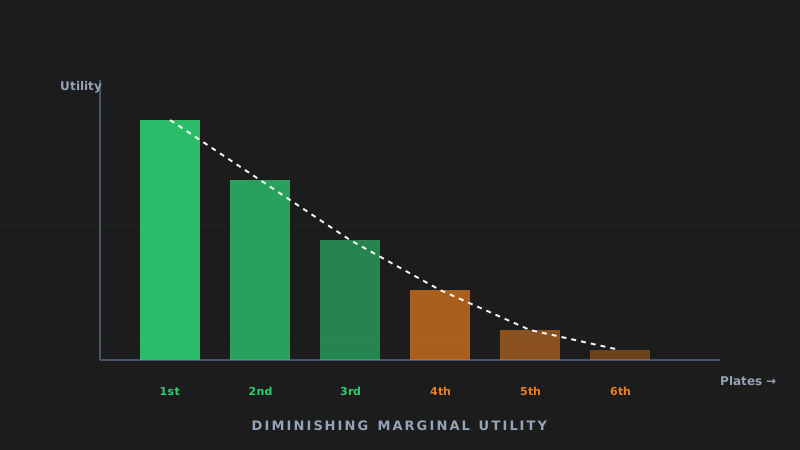
Diminishing marginal utility, in action
The core economic concept behind the buffet is diminishing marginal utility: the principle that each additional unit of a good provides less satisfaction than the one before. The first plate at a buffet is glorious — you're hungry, the options are abundant, every bite is a choice fulfilled. The second plate is good. The third is a duty. The fourth is a regret in progress.
This curve is the buffet's best friend. The customer arrives imagining they'll eat their money's worth — and they do, on the first two plates, which provide most of the utility. The marginal plates, the ones the customer imagined would push them into profit, provide almost no utility and cost the restaurant almost nothing in food cost (they're filled with the cheapest items: rice, pasta, bread). The customer leaves feeling they "got their money's worth" because they ate a lot, while the restaurant served them a high proportion of low-cost fillers. Both sides feel they won. That mutual satisfaction is the sign of a well-designed pricing model.
Average consumption per customer is predictable and moderate. The flat price is set above the average cost of food served. The variance in consumption — the small number of big eaters — is more than covered by the majority who eat less than the price implies.
How the buffet controls cost
Buffets are not random assortments of food. They are carefully engineered cost structures. Several techniques keep the average plate cost low:
- Cost-tiered placement. Cheap, filling items (rice, pasta, bread, salad) are placed at the front of the line, where hungry customers load up first. Expensive items (seafood, prime cuts) are placed later or portion-controlled by a server. By the time you reach the costly items, your plate is already full.
- Plate size. Smaller plates reduce the amount a customer takes per trip, increasing the friction of return trips and reducing total consumption. This is a choice-architecture intervention — the default portion is set by the plate.
- Visual abundance of cheap goods. The buffet looks lavish because the visible items are inexpensive. The impression of value is created by volume of low-cost goods, not by quantity of high-cost goods.
- Self-service labor savings. The buffet eliminates servers for food delivery. One server can cover many tables. Labor cost per customer drops, which is where much of the buffet's margin actually comes from — not from the food, but from the staffing.
The food cost at a buffet typically runs 30-35% of the price, comparable to or lower than a standard restaurant. The savings come from labor and from the predictable, moderate consumption pattern that the flat price is designed around.
The flat-rate bias
The buffet exploits a documented behavioral pattern called the "flat-rate bias": consumers systematically overestimate their usage under flat-rate plans and therefore prefer them even when a pay-per-use plan would be cheaper. This bias has been documented in telephone plans, gym memberships, and broadband subscriptions. Customers choose the flat rate because they imagine the worst case (heavy usage), not the average case (moderate usage), and the flat rate insures against the worst case at a premium they don't need to pay.
The same bias operates at the buffet. The customer imagines the scenario where they eat five plates and "beat" the fixed price. In reality, most customers eat two to three plates and the restaurant comes out ahead. The imagined big-eating scenario is the marketing; the actual average is the business model.
Why the customer still wins (a little)
It would be wrong to say the customer always loses. The buffet offers something the à la carte menu does not: optionality. The fixed price buys the right to eat as much as you want, even if you don't exercise it. For risk-averse consumers — those who dislike the uncertainty of a variable bill — the flat rate provides peace of mind. This is the same logic as loss aversion driving insurance purchases: people pay a premium to avoid the possibility of a large variable cost, even when the expected value favors the variable option.
For certain customers — big eaters, growing teenagers, people who genuinely value volume — the buffet is a positive-EV bet. The restaurant accepts these outliers because they are more than offset by the majority. This is the insurance principle: the pool covers the high-cost cases, and the average still works.
The broader flat-rate economy
The buffet's logic is everywhere once you look for it:
| Flat-rate product | What's "unlimited" | Why it works |
|---|---|---|
| Gym membership | Gym access | Most members rarely attend |
| Streaming subscription | Content viewing | Most users watch less than they imagine |
| Unlimited data plan | Data usage | Most users under their cap |
| Buffet | Food | Diminishing utility limits consumption |
| Software SaaS (flat tier) | Seats/features | Most teams underuse their tier |
In each case, the flat rate is priced above the average cost of provision, and the provider profits from the gap between imagined and actual usage. The consumer's bias — overestimating usage — is the product's margin.
Connecting to the wider FreakOnomics themes
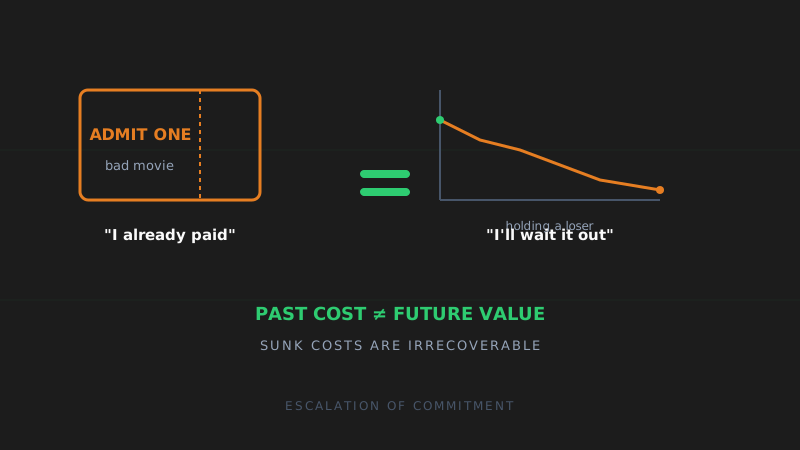
The buffet ties together several threads we've explored. The flat-rate bias is a cousin of the sunk cost fallacy: having paid the fixed price, the customer is motivated to "get their money's worth," eating past the point of enjoyment. This is why buffets generate more food waste than à la carte dining — the customer takes a fourth plate they don't really want, because the marginal cost of taking it feels like zero (the price is already paid). But the marginal cost isn't zero; it's just paid in advance. The waste is the visible residue of the sunk-cost error.
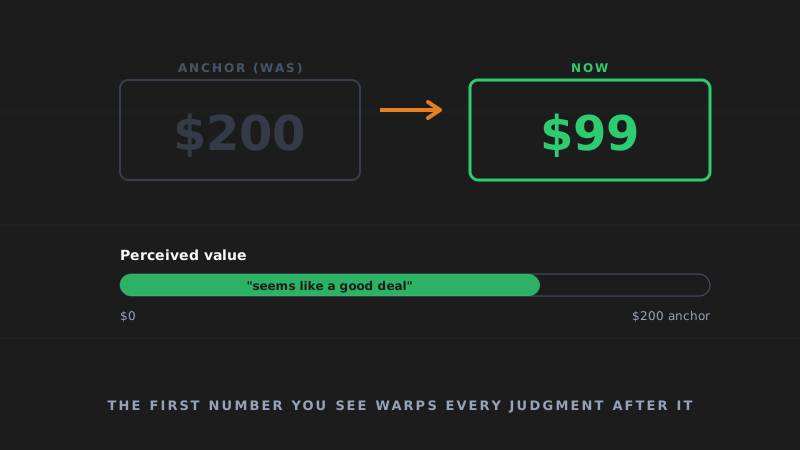
The buffet also relies on anchoring: the posted price sets an anchor for how much the customer should eat to "break even," and the customer calibrates consumption to that anchor rather than to their actual hunger. The economics of the buffet, like the economics of free, work by manipulating the customer's reference point.
The takeaway
The all-you-can-eat buffet is a small, complete lesson in pricing. It shows that flat-rate models profit from the gap between imagined and actual consumption. It shows that diminishing marginal utility is the restaurant's ally — the customer's own satiation limits the cost. And it shows that the customer's feeling of "winning" can coexist with the restaurant's profit, because the two sides are optimizing for different things: the customer for volume, the restaurant for margin.
The FreakOnomics lesson is not to avoid buffets. It is to recognize that the deal on offer — unlimited food for a fixed price — is not a gift. It is a wager, structured by the house, in which the house has the edge. You can still enjoy the meal. Just don't imagine you're beating the economics. The economics were designed before you walked in.