Here is a number: 1,200. Now answer this question: how old was Mahatma Gandhi when he died? If you're like most people in the classic experiment by Tversky and Kahneman, your estimate was dragged upward by the irrelevant 1,200 you saw a moment ago. You know Gandhi didn't live to 1,200. You know the number has nothing to do with the question. It moved your estimate anyway. That is anchoring, and it is arguably the single most exploited bias in commercial pricing.
The anchoring effect is the tendency for the first number encountered in a judgment to exert disproportionate influence on the final estimate, even when the number is obviously irrelevant. The effect is large, robust, and resistant to awareness — knowing about anchoring does not reliably immunize you against it. And it is the mechanism behind almost every "deal" you've ever felt good about.
The original experiment
In Tversky and Kahneman's 1974 study, participants watched a wheel of fortune that was rigged to stop at either 10 or 65. They were then asked whether the percentage of African nations in the United Nations was higher or lower than that number, and finally to estimate the actual percentage. Those who saw 10 estimated around 25%. Those who saw 65 estimated around 45%. The wheel's number was obviously random — participants knew this — yet it shifted their estimates by 20 percentage points.
The effect doesn't require a wheel of fortune. It works with any number that enters the cognitive frame before the judgment: a suggested list price, a competitor's higher price, a "regular price" on a tag, even a number plucked from the air in a negotiation. The anchor need not be plausible. Studies have shown that even absurdly high anchors (e.g., asking people whether a house is worth more or less than $10 million) raise subsequent estimates, even when everyone agrees $10 million is ridiculous. The anchor works because it sets the scale of the conversation, and the brain adjusts from there rather than starting fresh.
Anchoring is thought to operate through two routes: (1) insufficient adjustment — we start from the anchor and adjust toward the true value, but stop adjusting too early; and (2) priming — the anchor activates related concepts in memory, biasing the information we retrieve to evaluate the question. Either way, the first number contaminates the judgment.
Why "was/now" pricing is everywhere
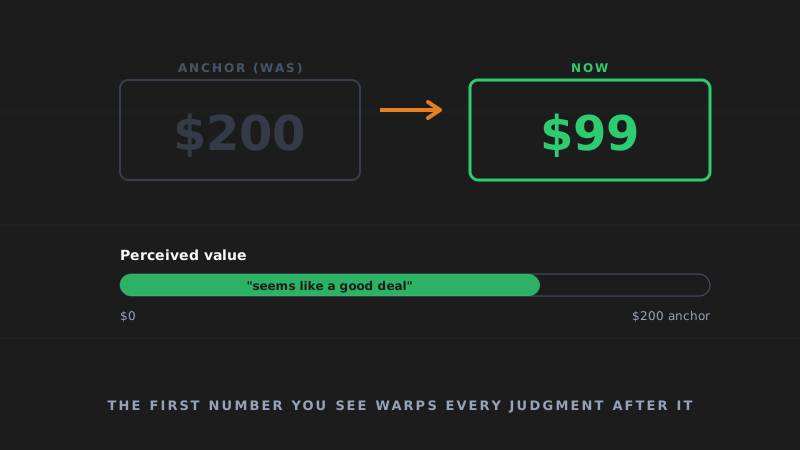
The commercial implications of anchoring are enormous, and they explain the ubiquity of "was/now" pricing. A sweater tagged "$200, now $99" is not communicating two pieces of information. It is deploying one anchor ($200) and one offer ($99), and relying on the anchor to make the offer feel like a gain. The consumer's brain does not independently assess whether $99 is a good price for the sweater. It assesses $99 relative to $200, and relative to $200, $99 feels like a victory.
This is why retailers resist removing the "was" price even when the item has been on sale for months. The anchor is doing the selling. Without it, $99 is just $99 — a number the consumer would evaluate on its own merits, possibly unfavorably. With it, $99 is a discount, and discounts feel like gains. The asymmetry of gains and losses makes the felt discount more compelling than the actual price: paying $99 feels like saving $101, and saving feels better than spending feels bad.
This connects directly to our analysis of Black Friday, where the "was" price is sometimes inflated specifically to deepen the apparent discount. The anchor is manufactured; the consumer cannot easily verify it; and even if they could, the anchor has already done its work on their perception by the time they finish checking.
Anchoring beyond price
Anchoring is not confined to commerce. It appears wherever a number precedes a judgment:
| Domain | The anchor | The warped judgment |
|---|---|---|
| Salary negotiation | First number stated | Final agreed amount clusters near it |
| Real estate | List price | Sale price and appraisals anchor to listing |
| Charitable giving | Suggested amounts | Donations cluster around suggestions |
| Sentencing | Prosecutor's recommendation | Judge's sentence anchors to it |
| Retail | "Was" price | Sale price perceived as deal regardless of value |
| Restaurant menus | Most expensive item | Mid-priced items seem reasonable |
The restaurant menu example deserves special mention. Many high-end restaurants place an extremely expensive item at the top of the menu — not because they expect to sell many, but because it anchors the rest of the menu. A $42 entrée feels extravagant next to a $20 burger, but reasonable next to a $95 steak. The $95 steak is the anchor; the $42 entrée is the target. This is sometimes called "decoy pricing," and it is pure anchoring applied to menu design.
Why awareness doesn't help
A troubling feature of anchoring is that knowing about it does not reliably reduce it. Studies where participants were explicitly warned about anchoring, or where they were educated about the bias before the experiment, still showed large anchoring effects. The anchor operates below the level of deliberate correction. By the time you're consciously evaluating the price, the anchor has already shaped the frame.
This is different from some other biases, where awareness provides partial protection. With anchoring, the contamination happens at the perception stage, before reasoning begins — and you cannot reason your way out of a perception that has already occurred. The only reliable defense is to avoid the anchor entirely, which is why price-comparison tools (which show market price rather than "was" price) are more effective than mental effort.
The MSRP illusion
Manufacturer's Suggested Retail Price (MSRP) is, in part, an anchoring instrument. The MSRP is set by the manufacturer, not the retailer, and it is often higher than the price at which the item actually sells. Its function is to establish an anchor that makes the street price look like a discount. In categories where MSRP is heavily enforced — electronics, automobiles — the "discount" off MSRP is a primary marketing message, even though almost no one pays MSRP. The anchor exists to be discounted from.
This is the same logic as the economics of free: the framing of the price (as a discount, as free, as a limited-time offer) does more work than the price itself. The consumer responds to the relationship between numbers, not to the numbers in isolation. Anchoring is the mechanism by which that relationship is engineered.
Connecting to the FreakOnomics themes
Anchoring sits at the center of the FreakOnomics web. It is why scarcity sales work (the "was" price anchors the "deal"). It is why suggested tip percentages creep upward (the suggested buttons anchor the customer's choice). It is why default contribution rates in retirement plans shape savings behavior (the default anchors the chosen rate). It is why buffet pricing sets a "break-even" target in the customer's mind (the posted price anchors the consumption goal). In each case, a number presented early shapes a decision made later — and the decision-maker is typically unaware of the influence.
The defensive economics
If awareness can't fully protect you, what can? The most effective strategies are structural rather than cognitive:
- Replace the anchor with data. Before evaluating a "deal," look up the item's actual price history and market range. This substitutes a real anchor (the market price) for the manufactured one (the "was" price).
- Evaluate prices in isolation. Ask: "Would I pay this amount for this item if I had never seen the 'was' price?" If the answer is no, the anchor is doing your deciding.
- Set your own anchor first. In negotiations, the party who states the first number sets the frame. Coming with a pre-researched number — your own anchor — prevents the other side's anchor from filling the vacuum.
- Ignore the crossed-out price. Literally cover it with your hand if you must. The "was" price is a signal designed to contaminate your judgment of the "now" price. Treating it as irrelevant is the only reliable way to reduce its effect.
The bottom line
Anchoring is the bias that makes pricing a psychological art rather than an accounting exercise. The original price is not information about the past; it is an instrument aimed at the present. Every "was/now" tag, every MSRP, every "suggested donation" is an anchor, and the anchor's job is to make the number that follows it feel like a relief.
The FreakOnomics lesson is that the first number is rarely the most important number — but it is almost always the most influential. The original price always seems reasonable not because it is, but because it arrived first. And in the economics of perception, arrival order is destiny.