Picture the scene: a parking lot full by 6 a.m., a line wrapped around the building, a countdown clock on the website, and a banner reading "Doorbusters — While Supplies Last." None of this is accidental. Black Friday is not a sale; it is a meticulously engineered economic event, designed to shift the demand curve to the right by manufacturing two things: scarcity and urgency. Understanding how those two levers work is understanding why Black Friday exists at all.
The conventional story is that Black Friday offers the year's best prices, and consumers rationally flock to capture them. The data tells a more complicated story. Multiple analyses of Black Friday pricing have found that a significant fraction of "deals" are not the lowest price of the year — many items are available at the same or lower prices at other times, and some "original prices" cited to compute the discount are inflated specifically for the occasion. If Black Friday were purely about price, it wouldn't need the countdown clocks, the limited stock, or the 5 a.m. opening. The theatrical elements are there because the price alone is not the point. The point is the environment.
Scarcity: the demand shifter
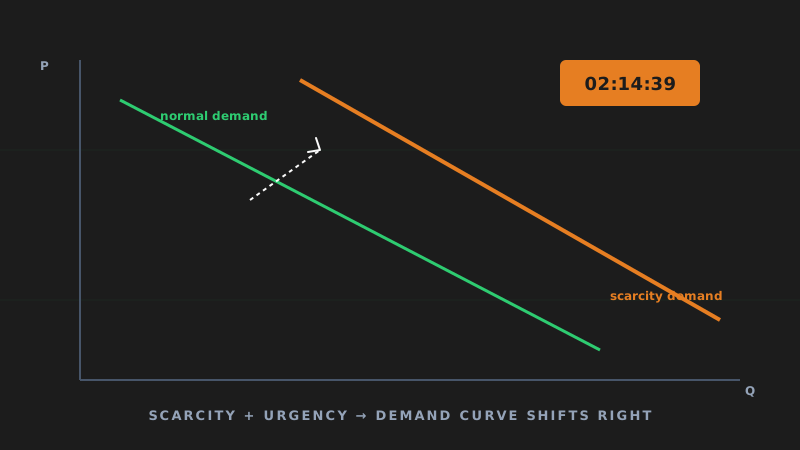
In standard microeconomics, scarcity affects supply, not demand. A limited supply raises the equilibrium price. But behavioral economics shows that scarcity also affects demand: when a good is perceived as scarce, consumers want it more. This is not rational in the standard model — the good's utility hasn't changed — but it is robustly documented. Limited-edition products sell faster. "Only 2 left in stock" notifications increase conversion. The perception of scarcity shifts the demand curve rightward: at any given price, more consumers are willing to buy.
Black Friday operationalizes this at scale. "Doorbuster" quantities are deliberately small — often single-digit units per store — not because the retailer can't get more, but because the small quantity generates the scarcity signal. The long lines and sold-out signs are not failures of inventory planning; they are the marketing. The scarcity is the product.
Perceived scarcity shifts the demand curve right: at every price, consumers demand more. The retailer can charge a higher equilibrium price — or, equivalently, sell more units at the "discounted" price than they would without the scarcity signal. The scarcity doesn't reduce supply; it increases demand.
Urgency: the time tax on deliberation
Scarcity says "there isn't much." Urgency says "there isn't much time." Together, they form a pincer on the consumer's decision-making. Urgency works by compressing the time available for deliberation — and deliberation is the consumer's main defense against impulse. Given time, you compare prices, check reviews, ask whether you need the item. Given a countdown, you buy.
This is why Black Friday deals are time-limited: the doorbusters expire, the online flash sales last hours, the "lowest price of the year" framing implies that waiting is costly. Each of these compresses the decision window. The consumer who would, given a week, research and decline, instead buys in the moment — because the architecture is designed to make the moment feel like the only chance.
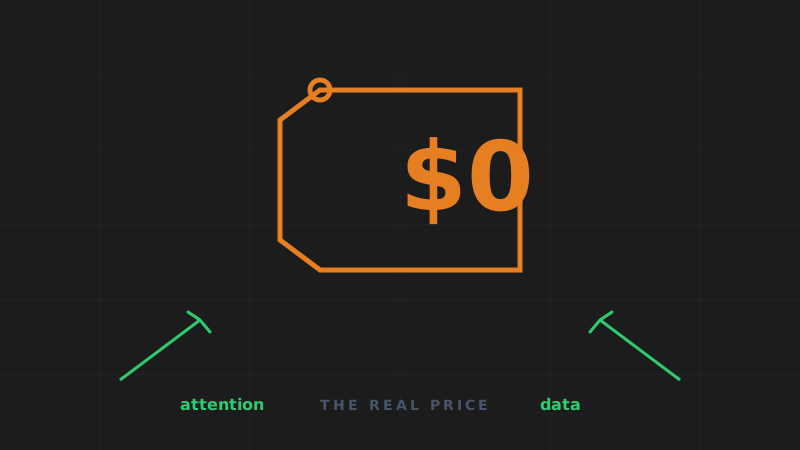
The mechanism is the same one we explored in the economics of free: a price signal (here, the time-limited discount) deactivates deliberation. The consumer stops asking "do I need this?" and starts asking "will I miss this deal?" — a very different question, and one that almost always answers itself in favor of buying.
The anchoring discount
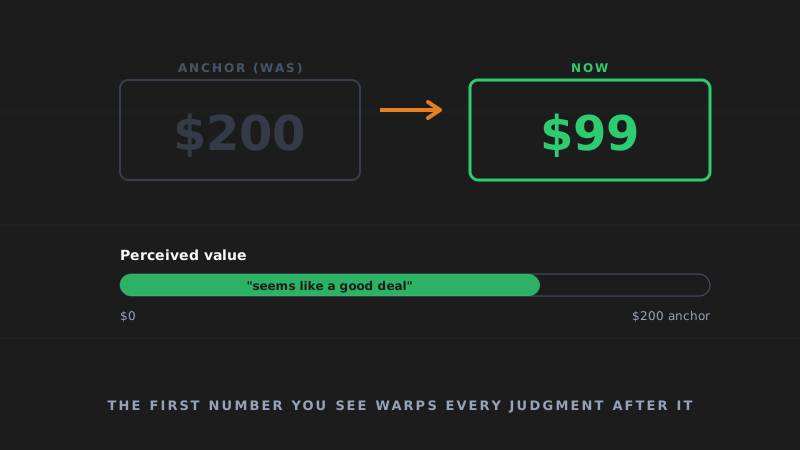
Black Friday's signature technique is the "was/now" price: a high original price (the anchor) crossed out, with a lower sale price below. The anchoring effect ensures the consumer evaluates the sale price relative to the anchor, not relative to the item's market value. A $200 sweater "marked down" to $99 feels like a steal — even if the sweater's actual market price, at competitors or at other times of year, is $92.
Investigations of Black Friday pricing have repeatedly found that a meaningful fraction of "original prices" are inflated for the occasion — set higher in the weeks before Black Friday so that the discount looks deeper. This is not illegal in most jurisdictions, but it is economically significant: the anchor is manufactured, the discount is theatrical, and the consumer's sense of getting a deal is the deliverable.
The loss leader structure
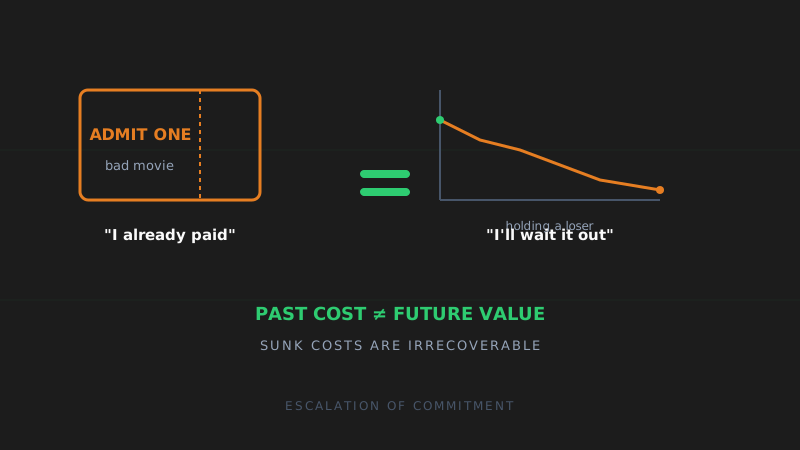
Black Friday's deepest discounts — the true doorbusters — are loss leaders: items sold at or below cost to draw traffic. The retailer loses money on the doorbuster but profits on everything else the customer buys while in the store or on the site. The doorbuster is the bait; the full-margin items are the catch. This is a classic two-part pricing structure, and it works because the customer, having come for the doorbuster, is reluctant to leave empty-handed — a manifestation of sunk-cost reasoning applied to the trip itself.
The structure is reinforced by the environment. The store is crowded, the music is loud, the deals are scattered — all of which increase cognitive load and reduce the consumer's capacity for careful price comparison. Under cognitive load, consumers fall back on heuristics: "it's Black Friday, so it must be a deal." The heuristic is the retailer's friend.
Why the deals aren't always deals
| Black Friday claim | The economic reality |
|---|---|
| "Lowest price of the year" | Often matched or beaten during off-peak sales |
| "Was $X, now $Y" | The "was" price is frequently inflated pre-sale |
| "While supplies last" | Supply is deliberately limited to generate scarcity |
| "Doorbuster deal" | Often a loss leader; full-margin items compensate |
| "Flash sale — 4 hours only" | Urgency compresses deliberation, increasing impulse buys |
None of this means Black Friday never offers genuine deals — it does, especially on specific categories like TVs, where manufacturers sometimes produce cheaper variants specifically for the occasion (fewer inputs, lower-grade panels) to hit a price point. But the general pattern is that the environment, not the price, is doing the work. The consumer buys more, and buys faster, than they would in a calmer setting — and that is the point.
The scarcity-urgency playbook beyond retail
Black Friday's techniques have been exported across the economy. Booking sites use "15 people are looking at this hotel" and "only 1 room left." Software companies use "offer ends at midnight." Online courses use "enrollment closes Friday." The structure is always the same: manufacture scarcity (limited quantity) and urgency (limited time) to shift the demand curve and compress deliberation. The FreakOnomics reader should recognize this pattern on sight — it is the most common pricing architecture in the digital economy, and it works because it is built on deeply wired responses to scarcity and time pressure.
These tactics borrow from the same playbook as tipping defaults and opt-out architecture: design the environment so that the desired behavior is the path of least resistance, and the undesired behavior (not buying, not tipping, opting out) requires active effort. The difference is that Black Friday applies the architecture to extract spending rather than compliance — but the mechanism is identical.
The defensive economics
You don't need to boycott Black Friday to avoid its traps. You need to restore the deliberation it is designed to remove:
- Price-track before you buy. Tools that show an item's price history reveal whether the "Black Friday deal" is actually the low. Many "deals" are at or above the item's typical price.
- Ignore the anchor. The crossed-out "was" price is a signal designed to warp your judgment. Evaluate the sale price on its own merits: is this item worth this number of dollars to you?
- Decide in advance. Make a list before the sale begins. Buy only what's on it. This pre-commits your deliberation to a calm moment, outside the urgency architecture.
- Recognize the scarcity as theater. "While supplies last" is almost always a choice, not a constraint. The scarcity exists to shift your demand, not to reflect the retailer's inventory.
The bottom line
Black Friday exists because scarcity and urgency work. They shift the demand curve, compress deliberation, and create an environment in which buying feels like winning. The genius of the event is not the prices — it is the architecture. The same consumer who would decline a $99 sweater in July buys it in November, not because the sweater changed, but because the environment did.
The FreakOnomics lesson is that the "deal" is the least important part of a sale event. The environment — the scarcity, the urgency, the anchor, the cognitive load — is what moves product. And the environment is always designed. The question is not "is this a good price?" but "why am I being encouraged to decide right now, in this exact frame?" The answer, almost always, is that the frame is the product.