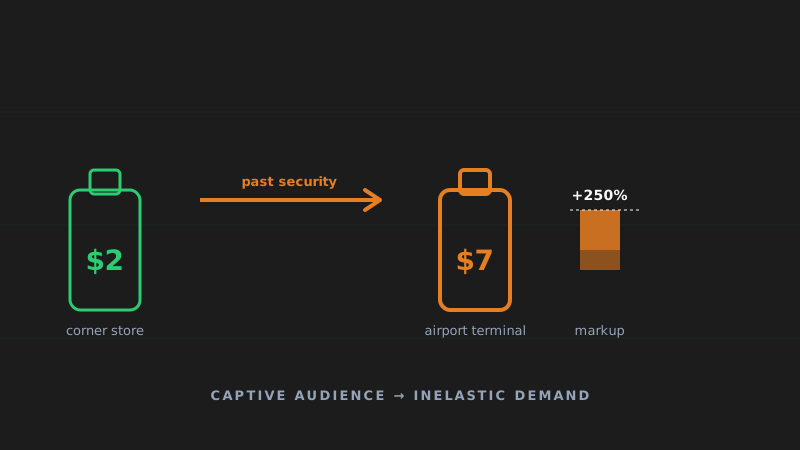
A bottle of water at a corner store costs about $1.50. The same bottle, past the security checkpoint at a major airport, costs $5.00 to $7.00. The water is identical. The plastic is identical. The supply chain is, if anything, more efficient at scale. So where does the 250% to 350% markup come from? It is not, as the tired complaint would have it, simple greed. It is the cold geometry of a captive market.
To understand airport pricing, you have to look at the structure of the choice a traveler faces after passing through security. They cannot leave and come back. They cannot have brought their own water through the checkpoint. They cannot comparison-shop across competing vendors, because the airport authority has leased limited retail space and the vendors inside are, effectively, a cartel of convenience. The traveler is a captive audience, and captive audiences face inelastic demand.
Price elasticity, in one paragraph
Price elasticity of demand measures how much quantity demanded falls when price rises. If a 10% price increase causes a 20% drop in demand, demand is elastic — the seller loses revenue by raising the price. If a 10% increase causes only a 2% drop, demand is inelastic — the seller gains revenue by raising the price. The rational seller raises prices until the marginal revenue gain from a higher price equals the marginal revenue loss from the customers who walk away.
In a competitive market, elasticity is high because customers can walk away to a competitor. In a captive market, elasticity is low because there is nowhere to walk to. The airport vendor's demand curve is steep: most travelers will pay $5 for water rather than go thirsty for four hours, even if they would never pay $5 at a store where a competitor offered it for $2. The captive market's defining feature is the absence of substitutes, and the absence of substitutes is what makes high prices stick.
A monopolist (or a cartel of limited sellers) prices where marginal revenue equals marginal cost. In a captive market, demand is inelastic, so this profit-maximizing price sits well above the competitive price. The gap is not a moral failing — it is the equilibrium of the market structure.
The geometry of captivity
Captive markets are defined by three structural features, and airports have all three in textbook form:
- Restricted exit. Once past security, a traveler cannot leave and re-enter without repeating the security process — a high transaction cost. The physical space functions as a closed system.
- Restricted entry. The airport authority controls which vendors operate. New competitors cannot enter to undercut the incumbents. The number of sellers is fixed by lease, not by market entry.
- Restricted substitutes. The TSA's liquid rules prevent travelers from bringing their own water. The most natural substitute — tap water or a personal bottle — has been regulated out of existence inside the secure area.
Each of these features reduces the traveler's set of alternatives. Reduced alternatives mean inelastic demand. Inelastic demand means higher equilibrium prices. The $5 water is not an anomaly; it is the system working as designed — not the traveler's design, and not the vendor's design, but the design of the market structure itself.
Captive markets beyond the terminal
Airports are the visible example, but the captive-market logic appears wherever substitutes are constrained:
| Captive Market | What's Restricted | Result |
|---|---|---|
| Movie theater concessions | No outside food; single vendor | $6 popcorn, $5 soda |
| Stadium food and drink | Same; plus event-limited duration | $12 beer, $9 hot dog |
| Hotel minibars | Late hour, no nearby stores | $8 candy bar |
| Theme parks | Re-entry restrictions, single operator | $20 meal, $4 bottled water |
| Highway rest stops | Distance between exits | Markup on fuel and food |
| Prison commissaries | Total captivity | Extreme markups on basics |
The pattern is consistent: when the customer cannot easily leave, cannot easily bring their own, and cannot easily find a competitor, prices rise to whatever the inelastic demand curve will bear. This is not a story about villainous vendors — it is a story about market structure determining price.
Is it a monopoly? Usually yes, technically.
Many captive markets are, in economic terms, local monopolies. The airport vendor doesn't have a monopoly on water — there is water everywhere — but it has a monopoly on water in that location at that time. Economists call this a "spatial monopoly." The relevant market is not "all water" but "water available to this traveler in the next two hours." Defined correctly, the market is tiny and the vendor is the only seller in it.
This is why competition policy struggles with captive markets. Antitrust law looks at market definition, and a narrow geographic/temporal market can look like an artificial construct. But to the thirsty traveler, the relevant market is exactly that narrow — and the price reflects it.
The markup is not pure profit
It is worth noting that the airport vendor's costs are also higher than the corner store's. Airport leases are expensive; security screening of deliveries adds cost; storage is constrained; labor must be badged and screened. The $5 water is not $3.50 of pure margin. But the structural costs explain only part of the markup. The remainder is the rent that inelastic demand allows the vendor to extract — what economists call "monopoly rent." The vendor charges $5 because the traveler will pay $5, not because the water costs $5 to provide.
This connects to a broader FreakOnomics theme we explore in our analysis of the market for lemons: prices are set by market structure, not by costs. Costs determine whether a seller participates; structure determines where, within the participating range, the price lands. In captive markets, structure lands the price high.
The traveler's defense
You cannot restructure the airport market. But you can change your own elasticity — the degree to which you are, personally, captive. A few practical moves:
- Carry an empty bottle. Most airports have water fountains or bottle-fill stations past security. The TSA allows empty bottles through. This is the single highest-leverage move: it restores your substitute at zero cost.
- Eat before security. The captive-market markup applies to food as much as water. A meal eaten landside is half the price of the same meal airside.
- Pre-commit to a budget. Decide in advance what you will and won't buy airside. Deciding under the influence of hunger and thirst is deciding inside the captive market's frame — and the frame is designed to extract.
- Recognize the structure. The anger we feel at airport prices is partly the anger of discovering, in real time, that we are inside a market designed to charge us more. Naming the structure doesn't lower the price, but it changes the decision from "why is this so expensive?" to "do I value this water at $5?" — which is the only question that matters once you're already captive.
The bigger picture
Captive markets are everywhere once you know how to see them. They are not failures of the market — they are a kind of market, and they price accordingly. The FreakOnomics lesson is not that airports are evil. It is that price is a function of the choices available to the buyer, and when those choices are restricted — by geography, by regulation, by lease, by checkpoint — the price reflects the restriction, not the cost.
The $5 bottle of water is the cleanest everyday illustration of this principle. It is the same water, in a different market. The difference is the market. And markets, as we keep finding, are less about what's being sold than about the structure within which it's sold.